Mar 02, 2026
Content
If you want the short answer: the best treadmill speed for weight loss is between 3.5 and 4.5 mph for walking, or 5 to 6 mph for jogging — depending on your current fitness level. These ranges keep your heart rate in the fat-burning zone (roughly 60–70% of your maximum heart rate) long enough to torch meaningful calories without burning out in the first ten minutes. That said, the "best" speed is not a fixed number. It shifts based on your body weight, age, fitness baseline, and how long you can sustain the effort.
A 180-pound person walking at 3.5 mph burns roughly 314 calories per hour. The same person jogging at 5.5 mph burns closer to 633 calories per hour. Speed matters — but consistency, duration, and workout structure matter just as much. The sections below break all of this down in practical terms.
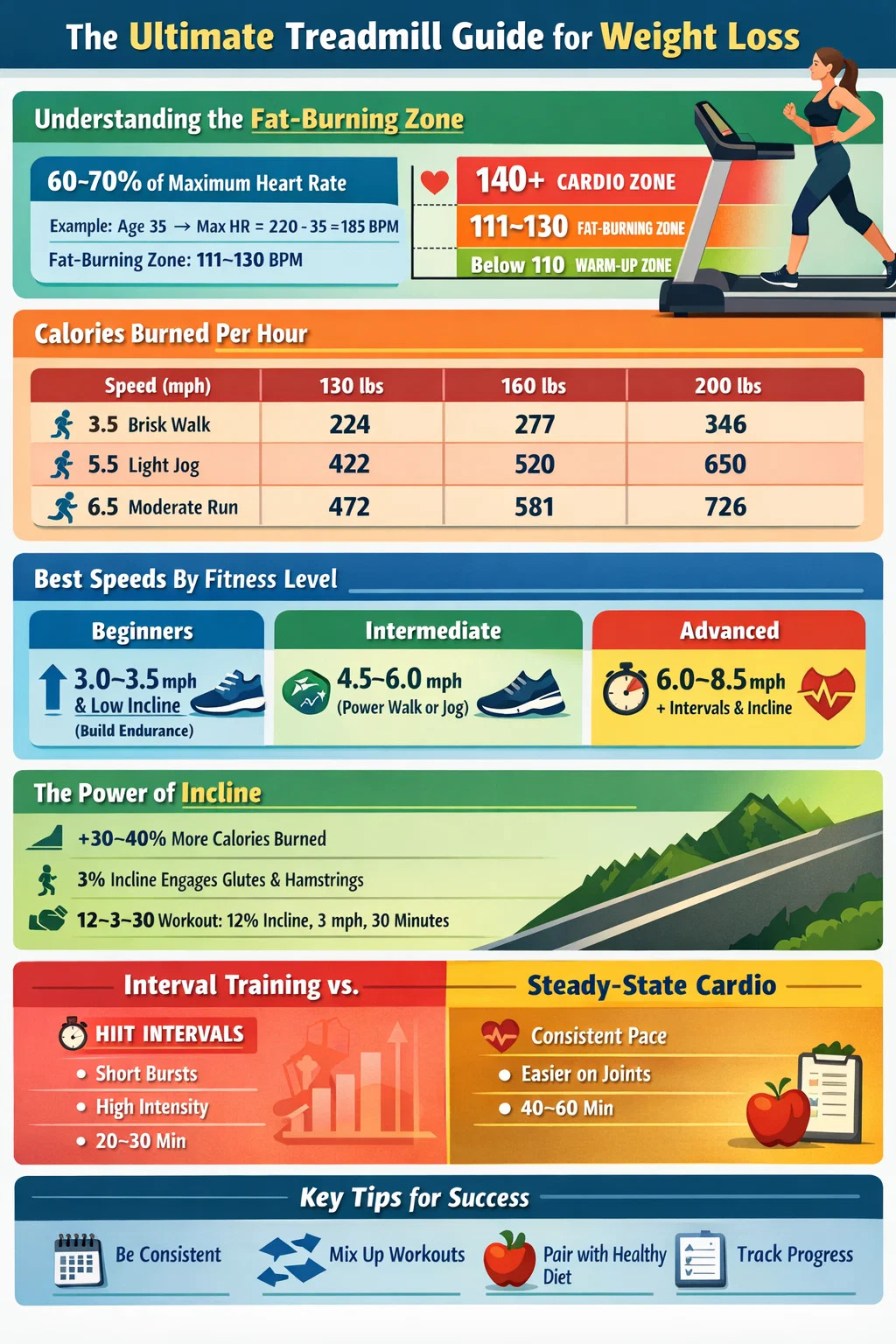
You have probably seen the "fat-burning zone" label on treadmill consoles. It refers to the heart rate range — typically 60–70% of your maximum heart rate — at which your body draws a higher percentage of energy from stored fat rather than quick-burning carbohydrates.
To estimate your maximum heart rate, subtract your age from 220. For a 35-year-old, that is 185 bpm. Their fat-burning zone sits between 111 and 130 bpm. At this intensity, fat supplies roughly 60% of the fuel, compared to around 35% at higher intensities.
Here is the nuance most people miss: even though a higher percentage of fat is burned at moderate speeds, total calorie burn at faster speeds is greater. An hour at 6 mph burns significantly more total calories — and more total fat in absolute grams — than an hour at 3.5 mph, even though the fat percentage is lower at the faster pace.
The fat-burning zone is most useful for beginners or people with joint issues who cannot sustain high-intensity efforts. For everyone else, mixing moderate and vigorous intensities produces the best long-term results.
The table below shows estimated calories burned per hour at various treadmill speeds for three different body weights. These figures come from metabolic equivalent (MET) calculations widely used in exercise science research.
| Speed (mph) | Activity | 130 lbs (cal/hr) | 160 lbs (cal/hr) | 200 lbs (cal/hr) |
|---|---|---|---|---|
| 2.5 | Slow walk | 177 | 218 | 272 |
| 3.5 | Brisk walk | 224 | 277 | 346 |
| 4.5 | Fast walk | 289 | 355 | 444 |
| 5.5 | Light jog | 422 | 520 | 650 |
| 6.5 | Moderate run | 472 | 581 | 726 |
| 8.0 | Fast run | 566 | 697 | 871 |
The jump from a brisk 3.5 mph walk to a 5.5 mph jog nearly doubles the caloric output. However, most people cannot sustain a 5.5 mph jog for a full hour when they are just starting out. That is why choosing a sustainable speed — one you can hold for 30 to 60 minutes — often beats chasing a faster pace you quit after 12 minutes.
Your starting point determines the smartest speed target. Here is how to approach it based on where you are right now.
Start at 3.0 to 3.5 mph with zero incline. The priority at this stage is building the habit of moving consistently for 30 minutes or more, not burning the maximum calories in a single session. Once you can walk comfortably at 3.5 mph for 45 minutes without feeling winded, increase speed by 0.2 mph or add 1% incline.
An incline of just 3–5% at 3.5 mph raises calorie burn by 20–30% and activates the glutes and hamstrings more than flat walking. This is a powerful tool for beginners who cannot yet run.
Target 4.5 to 6.0 mph. At this range, you are either power walking (4.5–4.8 mph) or entering a comfortable jogging pace (5.0–6.0 mph). Aim for sessions of 35–50 minutes at a pace where you can speak in short sentences but not hold a full conversation. This is the aerobic threshold — a strong weight-loss zone.
Try alternating between 4.5 mph (3 minutes) and 6.0 mph (2 minutes) within the same session. This simple interval structure burns more calories than a steady-state pace and keeps the workout engaging.
Work in the 6.0 to 8.5 mph range, incorporating incline runs and structured intervals. At this fitness level, HIIT (high-intensity interval training) on the treadmill — alternating between 8.0–9.0 mph sprints and 4.0 mph recovery walks — produces significant calorie burn, including the afterburn effect (excess post-exercise oxygen consumption, or EPOC).
Research published in the Journal of Strength and Conditioning Research found that HIIT sessions produced EPOC of up to 14% additional calorie burn in the hours following exercise, compared to steady-state cardio. This is one reason interval training at higher speeds can outperform longer slower runs for fat loss over time.
Speed alone is not the only lever on a treadmill. Incline is equally powerful for weight loss and is often underused. Walking uphill engages more muscle mass — particularly the glutes, calves, and core — which raises your heart rate and calorie burn without forcing you to run faster.
Consider this comparison: walking at 3.5 mph on flat ground burns roughly 277 calories per hour for a 160-pound person. The same speed at a 6% incline burns approximately 400 calories per hour — a 44% increase with no change in speed.
| Incline (%) | Speed (mph) | Calories/hr (160 lbs) | Primary Muscles Engaged |
|---|---|---|---|
| 0% | 3.5 | 277 | Quads, calves |
| 3% | 3.5 | 336 | Quads, glutes, core |
| 6% | 3.5 | 400 | Glutes, hamstrings, calves |
| 10% | 3.5 | 486 | Full posterior chain |
| 12% | 3.0 | 520 | Full posterior chain, hip flexors |
The "12-3-30" treadmill workout — popularized online — involves setting the treadmill to 12% incline, 3 mph speed, for 30 minutes. At those settings, a 160-pound person burns approximately 260 calories in 30 minutes, which is comparable to a 30-minute jog at 5.5 mph. It is an excellent option for people with knee issues or those who prefer walking over running.
Both approaches work. The difference lies in how your body responds over time and how much time you have available.
Maintaining a consistent speed — say 5.5 mph for 45 minutes — keeps your heart rate in a stable aerobic range. This is mentally easier to sustain, puts less stress on joints, and is ideal for recovery days or long endurance sessions. For weight loss, steady-state cardio works best when sessions are 40 minutes or longer. Below that threshold, total calorie burn is limited.
HIIT alternates between hard effort and recovery. A classic structure: 1 minute at 8.0–9.0 mph, then 2 minutes at 3.5–4.0 mph, repeated 8–10 times. This 27-minute workout can burn as many calories as 45 minutes of steady jogging — and the metabolic elevation lasts longer post-workout.
A 2017 meta-analysis in the journal Obesity Reviews found that HIIT reduced body fat mass more effectively than moderate-intensity continuous training, despite requiring less total time. The key mechanism is EPOC — your body continues burning elevated calories for up to 24 hours after an intense session.
HIIT is taxing, though. Most people should limit it to 2–3 sessions per week and fill remaining days with moderate steady-state cardio or strength training.
Duration and speed work together. There is no point running at 7 mph if you can only sustain it for 8 minutes. Here are evidence-based time targets by pace:
The American College of Sports Medicine recommends 150–250 minutes of moderate-intensity cardio per week for modest weight loss, and more than 250 minutes for significant fat reduction. That translates to five 30-to-50 minute sessions per week at a moderate pace.
Even with a good speed range, certain habits undermine results. Here are the most common ones:
Gripping the handrails reduces calorie burn by up to 20–25% at any given speed. If you need to hold on for balance, the speed or incline is too high. Reduce it and walk hands-free — your body will work significantly harder for the same pace.
Your body adapts to repeated stimuli within weeks. A workout that burned 350 calories in week one may only burn 290 calories in week eight — not because you are working less hard, but because your cardiovascular system has become more efficient. Rotate speeds, inclines, and session lengths every 3–4 weeks to prevent this adaptation.
Starting at full speed or stopping abruptly both increase injury risk and reduce workout quality. Spend 3–5 minutes at 2.5–3.0 mph before ramping up, and end the same way. This also improves cardiovascular recovery between sessions.
Treadmill workouts often trigger increased appetite, and it is easy to eat back every calorie burned — and then some. Research consistently shows that exercise alone, without any dietary adjustment, produces modest weight loss results. Combining treadmill cardio with a modest calorie deficit (300–500 calories below maintenance) is far more effective than cardio without dietary awareness.
Treadmill calorie counters are notoriously inaccurate — some studies suggest they overestimate by 10–15%. They also do not account for fitness level, muscle mass, or resting metabolic rate. Use them as rough guides, not exact figures.
Below are three structured weekly plans based on fitness level. Each plan targets calorie burn and fat loss through a combination of speed, incline, and session variety.
Not necessarily — and this is where a lot of people get confused. Running at 8 mph for 20 minutes burns roughly the same total calories as jogging at 5 mph for 32 minutes. The faster runner finishes sooner, but the slower runner reaches the same calorie target with less joint impact.
What matters more than speed alone is total energy expenditure across the week. Someone who jogs at 5.5 mph for 45 minutes five days a week will lose more fat over three months than someone who sprints at 9 mph for 15 minutes twice a week — regardless of intensity.
The practical takeaway: run or walk at the speed you can sustain most consistently without injury or burnout. That speed — whatever it is for your body right now — is your best speed for weight loss.
Weight fluctuates daily based on water retention, digestion, and hormonal cycles. Watching only the scale can be discouraging even when real fat loss is occurring. Use these additional markers to measure progress from your treadmill training:
There is no single universally correct treadmill speed for weight loss. The number that works for a 55-year-old with knee pain is completely different from what works for a 28-year-old who played college soccer. What the research and practical experience point to consistently is this:
For most people, a brisk 3.5–4.5 mph walk with incline or a moderate 5.0–6.0 mph jog — done consistently 4–5 times per week — will produce steady, sustainable fat loss. Speed is a tool, not the goal. Consistency is what actually moves the needle.
Hot Products

Phone: +86-152 5836 5876
TEL: +86-574 6322 1199
Email: mandy@evbfit.com
Address: No. 518 Zhengtong Road, Kandun Street, Cixi, Ningbo, Zhejiang, China
Copyright © Zhejiang Everbright Industry, Inc. All Rights Reserved. Custom Exercise Bikes Manufacturers China Stationary Bikes Factory