Mar 09, 2026
Content
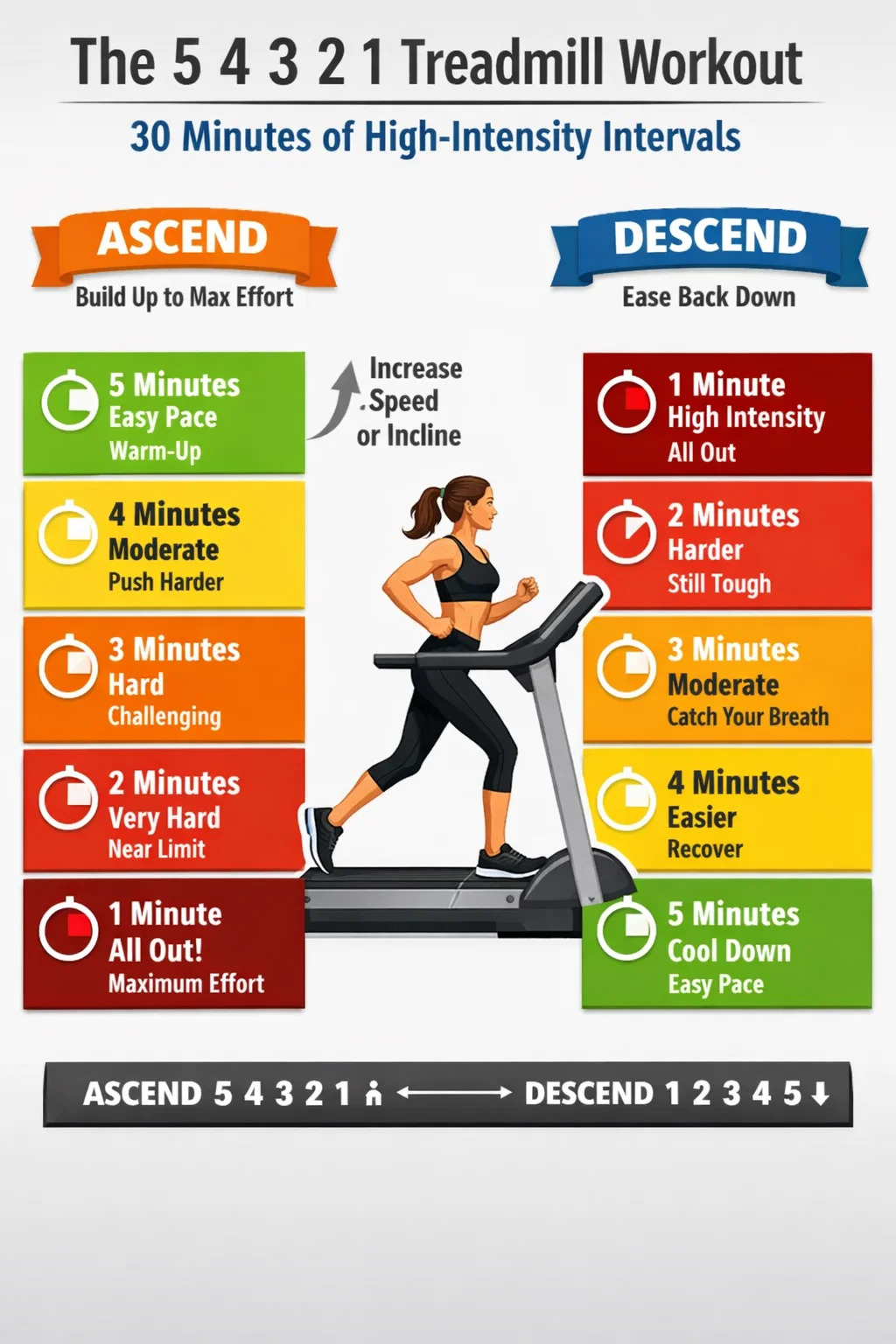
The 5 4 3 2 1 method on a treadmill is a structured interval workout where you cycle through five different time blocks — 5 minutes, 4 minutes, 3 minutes, 2 minutes, and 1 minute — at progressively increasing speeds or inclines, then reverse the sequence back down. The entire session typically lasts around 30 minutes, making it one of the most time-efficient treadmill workouts available for people who want real results without spending an hour on the machine.
In its most common form, you start with a 5-minute moderate-effort block, move to 4 minutes at a slightly harder pace, push through 3 minutes at a challenging speed, grind out 2 minutes near your limit, and finish with 1 minute at maximum effort. After reaching the peak, you reverse: 1 minute hard, 2 minutes slightly easier, and so on back down to 5 minutes at a recovery pace. Some versions of the workout include an incline component instead of speed changes, and others combine both.
The core appeal of the 5 4 3 2 1 treadmill method is its built-in structure. You always know exactly how long each block lasts, which removes the mental friction of deciding when to push harder or back off. This format suits beginners who need a roadmap and experienced runners who want a reliable high-intensity interval training (HIIT) framework.
Understanding what happens in each time block helps you calibrate your effort correctly and get the most out of every minute on the treadmill. Here is how a typical 5 4 3 2 1 workout is structured from start to finish.
The first 5 minutes serve a dual purpose. They warm up your muscles and cardiovascular system while establishing your base-level effort. For most people, this means a brisk walk or easy jog — something you could sustain while holding a conversation. On a treadmill, this might be somewhere between 3.5 mph and 5.5 mph depending on your fitness level. The incline is usually kept flat or at 1% to simulate outdoor running conditions.
Here you increase the speed or incline by a meaningful increment. You should feel your breathing deepen and your legs start to work harder, but you are not yet struggling. Think of this as the point where you could still speak in short sentences but would not want to hold a full conversation. Many runners add 0.5 to 1.0 mph compared to the 5-minute block, or bump the incline to 3–4%.
Three minutes at a challenging but sustainable pace. Your heart rate is climbing toward 75–85% of your maximum, and you are focusing on maintaining form. The shorter duration allows you to push harder than you did during the 4-minute block. This is where the aerobic and anaerobic systems start working together.
Two minutes is short enough that you can push hard — genuinely hard. Your breathing is labored, your legs are burning slightly, and you are likely near 85–90% of your maximum heart rate. Speed increases of 1.0 to 1.5 mph over your base pace are common here, or inclines in the 6–8% range for incline-based versions.
One minute at your hardest sustainable effort. This is a sprint or near-sprint — everything you have. Because it is only 60 seconds, you should be able to go all-out without risking injury, as long as your warm-up was adequate. After this peak, the workout reverses back through the sequence: 1 minute, 2 minutes, 3 minutes, 4 minutes, and 5 minutes at descending intensities, ending with a cool-down walk.
The beauty of this treadmill method is that the same structure scales across fitness levels. Below are three versions — beginner, intermediate, and advanced — using speed as the primary variable. Incline is kept at 1% throughout to simulate road running resistance. Adjust these numbers based on your personal comfort and capability.
| Interval Block | Beginner (mph) | Intermediate (mph) | Advanced (mph) |
|---|---|---|---|
| 5 Minutes (easy) | 3.0 – 3.5 | 4.5 – 5.0 | 6.0 – 6.5 |
| 4 Minutes (moderate) | 3.8 – 4.2 | 5.5 – 6.0 | 7.0 – 7.5 |
| 3 Minutes (hard) | 4.5 – 5.0 | 6.5 – 7.0 | 8.0 – 8.5 |
| 2 Minutes (very hard) | 5.2 – 5.8 | 7.5 – 8.0 | 9.0 – 9.5 |
| 1 Minute (maximum) | 6.0 – 6.5 | 8.5 – 9.0 | 10.0 – 11.0 |
After the 1-minute peak, reverse the sequence back down, reducing speed at each step until you finish with another 5-minute easy block as your cool-down. The total workout time with both the ascending and descending phases is 30 minutes (5+4+3+2+1+1+2+3+4+5 = 30). Adding a 5-minute warm-up walk before you begin brings the session to 35 minutes total.
One highly effective variation of this treadmill workout keeps speed constant and manipulates incline instead. This approach is particularly useful for people who want to build leg strength, improve glute activation, and burn more calories without the joint stress that comes with high-speed running.
Research published in the Journal of Sports Sciences has shown that treadmill running at a 5% incline increases caloric expenditure by approximately 17% compared to flat running at the same speed. At a 10% incline, that figure jumps to nearly 35%. The 5 4 3 2 1 incline method takes advantage of this by systematically increasing the grade through each interval.
A typical incline version might look like this:
Then descend back through the sequence. This version is excellent for people rehabbing knee injuries who cannot tolerate high-impact speed work, or for anyone whose primary goal is lower-body toning and fat loss rather than cardiovascular speed development.
The effectiveness of this treadmill method comes down to well-established exercise physiology principles. When you alternate between effort levels, your body must continually readjust its oxygen demand, heart rate, and metabolic output. This creates a training stimulus that is significantly more powerful than steady-state cardio over the same duration.
One of the most significant physiological benefits of interval-based treadmill training is excess post-exercise oxygen consumption, commonly called EPOC or the "afterburn effect." After a high-intensity workout, your body continues burning calories at an elevated rate as it works to restore normal physiological conditions — replenishing oxygen stores, removing lactic acid, repairing muscle tissue, and normalizing hormone levels. Studies have found that EPOC from HIIT-style workouts can elevate metabolism for up to 24–48 hours post-exercise, contributing meaningfully to total caloric expenditure beyond what the workout itself burns.
VO2 max — the maximum rate at which your body can consume oxygen during exercise — is one of the strongest predictors of long-term cardiovascular health and athletic performance. The high-intensity intervals in the 5 4 3 2 1 method push your body close to its VO2 max ceiling repeatedly, which signals adaptations that raise that ceiling over time. A 2019 meta-analysis in the British Journal of Sports Medicine found that HIIT was significantly more effective at improving VO2 max than moderate-intensity continuous training over the same training period.
Interval training increases the number and efficiency of mitochondria in muscle cells — the organelles responsible for converting fat and carbohydrates into usable energy. More mitochondria means your muscles become more efficient at burning fat as fuel, even at rest. This adaptation makes the 5 4 3 2 1 treadmill method particularly useful for people whose primary goal is body composition change rather than just cardiovascular fitness.
Exact calorie burn depends on body weight, fitness level, speed settings, and incline, but general estimates give a useful benchmark. A 150-pound (68 kg) person doing a moderate-intensity version of this 30-minute treadmill workout will typically burn between 280 and 380 calories during the session itself. Factor in the EPOC effect, and the total energy expenditure over the following 24 hours can add another 50–100 calories on top of that baseline.
Compare this to 30 minutes of steady-state jogging at 5 mph, which burns roughly 240–270 calories for the same person. The 5 4 3 2 1 method consistently outperforms steady-state cardio in total caloric impact for equivalent workout durations, which is one of the main reasons it has gained popularity among people using treadmills for weight loss.
| Body Weight | Beginner Intensity | Moderate Intensity | High Intensity |
|---|---|---|---|
| 120 lbs (54 kg) | 190 – 220 kcal | 240 – 280 kcal | 300 – 340 kcal |
| 150 lbs (68 kg) | 230 – 270 kcal | 290 – 340 kcal | 360 – 410 kcal |
| 180 lbs (82 kg) | 275 – 320 kcal | 340 – 395 kcal | 420 – 475 kcal |
| 210 lbs (95 kg) | 315 – 365 kcal | 390 – 450 kcal | 480 – 540 kcal |
Calorie burn is often the first thing people focus on, but the 5 4 3 2 1 method delivers a broader range of benefits that make it worthwhile regardless of your goals.
One of the biggest problems people have with treadmill running is boredom. Staring at the same wall while jogging at a fixed pace for 45 minutes is genuinely tedious for most people. The 5 4 3 2 1 structure eliminates that problem by giving your mind a constant task: monitoring the timer, anticipating the next intensity shift, and managing your effort. The countdown nature of the format — knowing you only have 3 more minutes, then 2, then just 1 — provides psychological momentum that steady-state cardio simply cannot match.
Repeatedly challenging your cardiovascular system to ramp up and then recover during a treadmill session trains your heart to become more efficient at both acceleration and deceleration. Over time, this leads to lower resting heart rate, improved stroke volume (the amount of blood pumped per beat), and better overall cardiac efficiency. These are markers not just of athletic fitness but of long-term heart health.
The 5 4 3 2 1 treadmill format works for runners who want to build speed, walkers who need a structured fat-burning session, athletes using the treadmill as cross-training, and anyone in between. By adjusting the speed and incline ranges, you can target fat loss, aerobic base building, lactate threshold improvement, or sprint development — all within the same structural framework.
At 30 minutes for the core workout (or 35–40 minutes with warm-up and cool-down), the 5 4 3 2 1 method fits into tight schedules without sacrificing training quality. For comparison, the American College of Sports Medicine recommends 150 minutes of moderate-intensity or 75 minutes of vigorous-intensity cardio per week for health maintenance. Three sessions of the 5 4 3 2 1 method per week covers nearly the full vigorous-intensity recommendation at just 90–105 minutes total.
Even a well-designed workout structure can deliver poor results — or cause injury — if executed with poor habits. These are the most frequent errors people make when trying the 5 4 3 2 1 treadmill method for the first time.
The most common mistake is setting the initial 5-minute block at a pace that is already too demanding, which means there is nowhere meaningful to go by the time you reach the 1-minute peak. The 5-minute block should genuinely feel easy — a pace you could hold for 30 minutes on its own without much strain. If your first block feels hard, you have set your baseline too high and will burn out before the workout is complete.
Gripping the treadmill handrails reduces the actual workload dramatically and disrupts your natural running or walking biomechanics. Studies have shown that holding handrails while using a treadmill at a 10% incline can reduce caloric expenditure by as much as 40% compared to hands-free exercise at the same settings. Let your arms swing freely, and if you need to hold on for balance, reduce the speed or incline until you can go without.
Some people hit the 1-minute peak and immediately step off the treadmill or drop to a complete stop. This is a mistake both physiologically and structurally. The descending sequence is an active recovery phase that helps clear lactic acid, gradually lowers your heart rate, and reinforces the aerobic base work. Skipping it can cause blood pooling in the legs and leaves your heart rate high without a proper cool-down.
Because the 5 4 3 2 1 method is accessible and feels satisfying, some people want to do it daily. This is counterproductive. High-intensity interval training requires recovery time — at least 24–48 hours between sessions. Doing it every day leads to cumulative fatigue, increased injury risk, and diminishing returns. Two to three sessions per week is the recommended frequency, with lower-intensity treadmill walking or rest on other days.
One of the marks of any good workout method is that it can grow with you. The 5 4 3 2 1 structure supports progressive overload — the principle that you must continually increase the training stimulus to keep improving — in several ways.
Yes — and it is among the more efficient treadmill-based approaches to fat loss available. The combination of elevated calorie burn during the workout, meaningful EPOC afterward, and the metabolic adaptations that come from consistent interval training creates a multi-pronged fat loss stimulus that steady-state cardio does not replicate as effectively.
That said, the treadmill alone — regardless of the workout format — will not produce significant body composition changes without appropriate dietary support. Weight loss comes down to total energy balance. The 5 4 3 2 1 method helps by increasing the caloric deficit side of that equation more efficiently than lower-intensity treadmill options.
For people specifically targeting fat loss, the incline-focused version of this workout is worth considering. Walking at high inclines activates the glutes, hamstrings, and calves more deeply than flat running, which builds more lower-body muscle mass over time. More muscle mass raises your resting metabolic rate — the number of calories your body burns doing nothing — which compounds the fat loss effect over weeks and months.
A realistic expectation: someone doing this treadmill workout 3 times per week alongside a modest caloric deficit of 300–400 calories per day could expect to lose approximately 0.75 to 1 pound per week of fat — a sustainable and healthy rate that avoids the muscle loss associated with more aggressive deficits.
Optimizing your environment and habits around the workout can significantly improve both the results and the experience.
This treadmill workout is suitable for a wide range of people, but it is not appropriate for everyone in every situation. Understanding where it fits — and where it does not — helps you make better decisions about incorporating it into your routine.
There are several other structured treadmill workout methods in common use. Understanding how the 5 4 3 2 1 approach compares to them helps you decide where it fits in your overall training schedule.
| Method | Duration | Structure | Best For |
|---|---|---|---|
| 5 4 3 2 1 Method | 30 min | Pyramid intervals | Fat loss, cardio fitness, all levels |
| 12-3-30 Method | 30 min | Fixed incline walk | Low-impact fat loss, beginners |
| Tabata Sprints | 20 min | 20s on / 10s off | Speed, VO2 max, advanced |
| Steady-State Jog | 30–60 min | Fixed pace | Aerobic base, easy recovery |
| Fartlek Running | Variable | Unstructured intervals | Experienced runners, variety |
The 5 4 3 2 1 method occupies a useful middle ground. It is more demanding than the 12-3-30 method but more structured and approachable than pure Tabata sprints. It produces more metabolic impact than steady-state jogging while remaining scalable enough for people who are not yet ready for the extreme intensities that Tabata demands. For most people, it is the most versatile option on the list.
Hot Products

Phone: +86-152 5836 5876
TEL: +86-574 6322 1199
Email: mandy@evbfit.com
Address: No. 518 Zhengtong Road, Kandun Street, Cixi, Ningbo, Zhejiang, China
Copyright © Zhejiang Everbright Industry, Inc. All Rights Reserved. Custom Exercise Bikes Manufacturers China Stationary Bikes Factory