Mar 16, 2026
Content
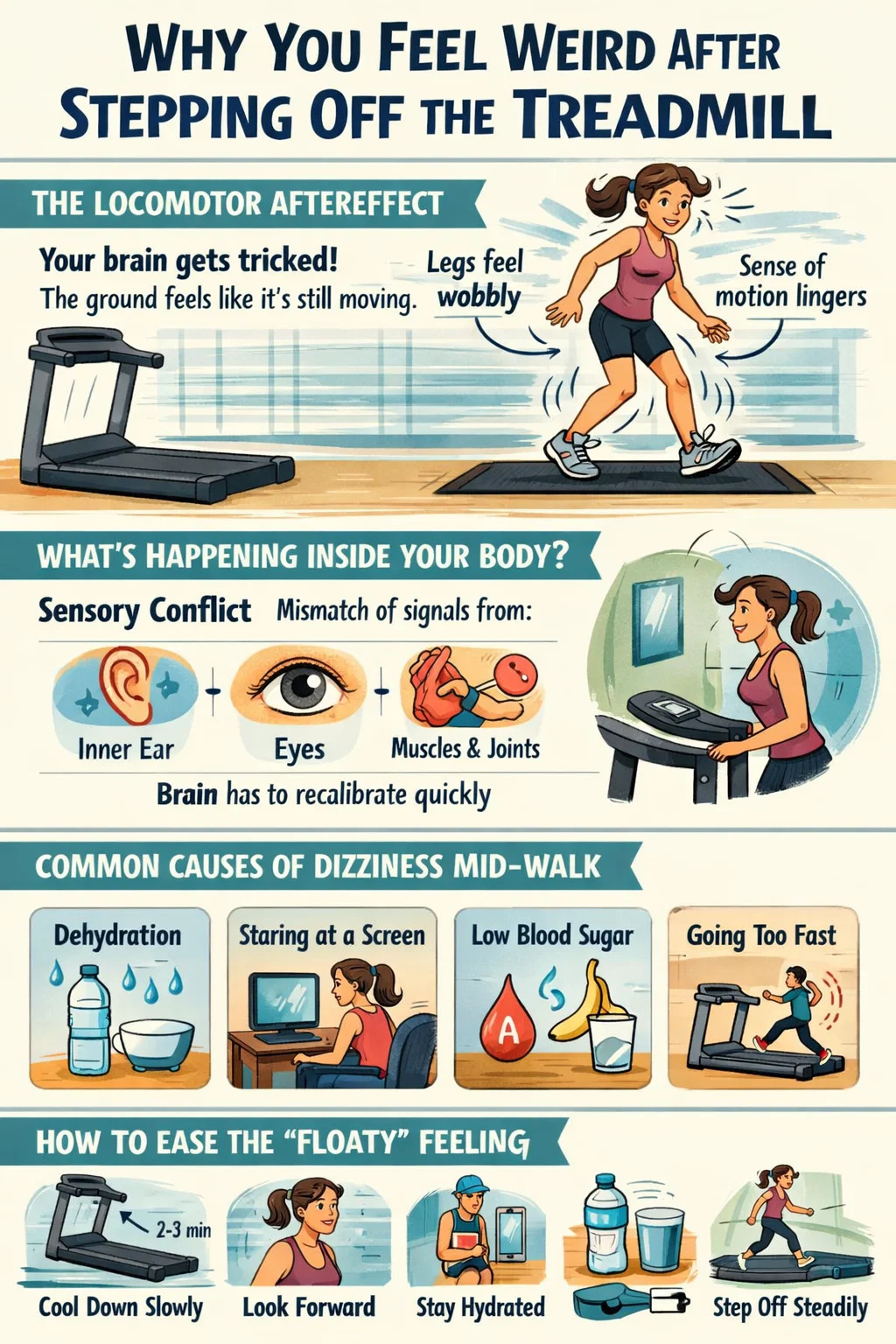
That strange, floaty, or unsteady feeling you get after stepping off a treadmill has a name — it's called treadmill-induced locomotor aftereffect, and it's completely normal. When you walk on a treadmill, your brain adjusts to the sensation of a moving belt beneath your feet. The moment you step off, your legs and balance system keep expecting that motion, but the ground doesn't move. The result? You feel like the floor is shifting, your legs feel heavy or springy, and your whole body seems slightly off.
This happens to most people who use a treadmill, especially beginners or those who've just had a longer session. It typically fades within a few seconds to a couple of minutes. But in some cases, the weird feeling lasts longer or involves dizziness, nausea, or visual disturbances — and those have different explanations worth understanding.
Your sense of balance and movement depends on three systems working together: your vestibular system (inner ear), your visual system (eyes), and your proprioceptive system (sensory receptors in muscles and joints). During treadmill walking, these three systems receive slightly conflicting signals compared to walking outside.
Outside, when you walk forward, your eyes see the environment shifting behind you, your legs move, and your inner ear detects forward motion. On a treadmill, your legs are moving, but your eyes see a fixed wall or screen, and your inner ear registers little to no forward displacement. Your brain has to reconcile these mismatched inputs, and it does — but the adjustment lingers after you stop.
Research published in the journal Experimental Brain Research has shown that after treadmill walking, people walking on a stationary surface tend to veer sideways or feel like they're still being propelled forward. The motor patterns your nervous system locked in during the treadmill session don't switch off instantly. Studies using gait analysis equipment found that step frequency and stride length remain altered for up to 15–20 seconds after stepping off, even in healthy adults with regular exercise habits.
Essentially, your legs and nervous system are still running the treadmill program. Your brain needs a few moments to reboot to normal ground walking.
Feeling dizzy while you're still on the treadmill is a different situation. This is more likely tied to physiological causes rather than pure sensory confusion. Here are the most common reasons:
Even mild dehydration — as little as 1–2% of body weight in fluid loss — can cause lightheadedness during exercise. When you walk at a brisk pace, you sweat more than you might realize, especially indoors where ventilation is limited. Your blood volume drops slightly, reducing oxygen delivery to the brain, and dizziness follows. Drinking 200–300ml of water 30 minutes before a treadmill session reduces this risk substantially.
A very common but overlooked cause. When you focus intensely on a TV screen, a wall, or the treadmill console while walking, your visual system is sending a "stationary" message to your brain while your body is in full motion. This visual-vestibular mismatch can cause a motion-sickness-like dizziness. This is the same mechanism that makes some people feel sick reading in a moving car.
Walking on a treadmill for more than 30–40 minutes in a fasted state can drop blood glucose low enough to cause lightheadedness, weakness, or nausea. This is more likely in the morning before breakfast. A small snack containing carbohydrates — like a banana or a slice of toast — roughly 30–60 minutes before your session keeps your glucose stable and your head clear.
Jumping on a treadmill and immediately selecting a fast speed causes a rapid increase in heart rate. Blood flow gets redirected to working muscles, and if your cardiovascular system hasn't had time to warm up, blood pressure regulation can lag behind. The result is often a brief episode of dizziness or lightheadedness. Starting at a slow pace for at least 3–5 minutes before increasing speed allows your circulatory system to adapt gradually.
Nausea following a treadmill session is more than annoying — it's your body signaling that something was out of balance during the workout. The most frequent culprits are:
If nausea is recurring after every treadmill session, it's worth reviewing your pre-workout meal timing and hydration habits before assuming anything more serious is at play.
Many people describe their legs feeling "like jelly," oddly springy, or like they're walking on a moving surface after stepping off the treadmill. This is one of the most reported post-treadmill sensations, and the cause is well-documented.
During treadmill walking, your leg muscles work in a rhythmic, repetitive pattern driven partly by the belt's movement. Your muscles become somewhat reliant on the belt's momentum as part of their movement cycle. When you step onto stationary ground, that external assist is gone. Your legs suddenly have to do 100% of the propulsion work without the belt's assistance, but your motor patterns haven't caught up yet. This creates the rubbery or springy sensation.
This is particularly noticeable after longer treadmill sessions — anything over 20–30 minutes tends to produce a more pronounced aftereffect. The phenomenon is sometimes called "treadmill legs" informally, and it typically resolves within 30–60 seconds for most healthy adults.
It's useful to distinguish between two separate things that can both make your legs feel weird:
| Feature | Sensory Aftereffect | Muscle Fatigue |
|---|---|---|
| Onset | Immediately on stepping off | During or just after intense effort |
| Duration | Seconds to 1–2 minutes | Minutes to hours |
| Sensation | Springy, floating, ground-moving | Heavy, burning, weak |
| Worrisome? | No, entirely normal | Normal unless severe or sudden |
Not all treadmill sessions produce the same aftereffect. The intensity and settings you use have a direct impact on how disoriented you feel afterward.
Walking at a steep incline — say, 10–15% grade — places substantially greater demand on your calves, hamstrings, and glutes. It also changes your posture and the way your body distributes weight. After stepping off from a prolonged incline walk, some people feel a dramatic shift in how their legs and lower back feel on flat ground. The muscles involved in compensating for the incline don't immediately reset, which can produce a stumbling or uneven walking sensation.
The faster the treadmill belt, the stronger the locomotor aftereffect once you stop. Studies have found that subjects walking at 6 km/h or faster showed more pronounced gait deviations post-treadmill compared to those walking at 3–4 km/h. The brain's recalibration effort is larger when the speed difference between "treadmill world" and "real world" is bigger.
A 10-minute easy walk produces minimal aftereffect. A 60-minute session at moderate pace can leave you feeling noticeably strange afterward. The longer the exposure to the treadmill's artificial movement environment, the deeper the neural adaptation, and the longer it takes to reverse. This is the same reason that sailors feel unsteady on land after weeks at sea — the principle of sensory adaptation applies across different scales.
Most of the post-treadmill strangeness is unavoidable to some degree, but several practical steps can significantly reduce both the intensity and duration of the sensation.
Rather than stepping off abruptly at full speed, gradually reduce your treadmill speed over 3–5 minutes before stopping. This gives your nervous system and cardiovascular system time to start transitioning before you hit stationary ground. Ending your session at 2.0–2.5 km/h for two minutes before stepping off is one of the most effective ways to reduce the "floating legs" sensation.
Fixing your gaze on a distant, stable point rather than a close screen or the treadmill console reduces visual-vestibular conflict during your session. This directly lowers the severity of dizziness and disorientation when you step off. If you use a screen for entertainment, placing it at eye level and slightly further away — rather than close and angled — helps reduce the effect.
Drink at least 500ml of water in the hour before your treadmill session. For sessions lasting 45 minutes or more, sip water during the walk — around 150–200ml every 15–20 minutes is a reasonable guideline. This prevents the blood volume drop that amplifies dizziness.
Many treadmill users grip the handrails constantly, which actually worsens the sensory mismatch. Holding on limits the natural arm swing that helps calibrate your proprioceptive system. Use the handrails only for brief balance checks, not continuous support. Walking without holding anything gives your brain better sensory feedback and reduces adaptation depth.
When you do step off, pause on solid ground for 15–30 seconds before walking away. This short pause allows your nervous system to recalibrate without you stumbling around during the adjustment. Some people find it helpful to look at the ground during this moment, giving their visual system a static reference point to anchor to.
People who switch between treadmill and outdoor walking frequently notice that the two feel quite different — not just in scenery, but in how their body responds. This isn't imagination.
Outdoors, you're propelling yourself forward through space. On a treadmill, the belt moves under you, and your job is mainly to keep up. Biomechanical studies comparing the two consistently find differences in:
These differences explain why the post-treadmill transition back to overground walking feels so jarring. The two activities share the name "walking" but produce meaningfully different neuromuscular patterns.
The vast majority of post-treadmill strangeness is benign. However, there are specific situations where the symptoms you experience warrant proper medical attention rather than just waiting it out.
Pay attention if you experience:
People with known cardiovascular conditions, inner ear disorders, or who are taking medications that affect blood pressure should discuss treadmill exercise with their doctor before starting a regular routine. Certain medications — including beta-blockers and some antihypertensives — blunt the normal cardiovascular response to exercise, which can produce unusual symptoms.
Yes — and this is one of the more encouraging aspects of the whole phenomenon. The more regularly you use a treadmill, the better your nervous system gets at switching between treadmill and overground gait patterns. Regular treadmill users report that the post-session disorientation diminishes significantly after two to four weeks of consistent use.
This happens because neural plasticity allows your brain to maintain both movement programs — the treadmill version and the overground version — and toggle between them more efficiently. First-time treadmill users almost universally experience stronger aftereffects than experienced ones. If you're new to treadmill walking and finding the post-session strangeness uncomfortable, consistency is the remedy.
Some gym-goers also find that alternating treadmill sessions with outdoor walks helps their nervous system stay adaptable to both environments and reduces the depth of adaptation to either one exclusively.
Yes, mild dizziness after a 20-minute session is common, especially if you stopped the belt abruptly or stared at a fixed screen throughout. It usually fades in under a minute. If it persists longer or feels severe, review your hydration and cool-down habits.
This is the locomotor aftereffect. Your nervous system built a movement model during your session that doesn't switch off the moment the belt stops. It's the same reason roller-coaster riders feel like they're still moving after getting off. It resolves on its own within seconds to a minute or two.
For people with existing inner ear conditions like BPPV (benign paroxysmal positional vertigo) or vestibular neuritis, treadmill use can temporarily exacerbate symptoms because of the strong sensory mismatch it creates. If you have a diagnosed vestibular disorder, consult your healthcare provider about whether treadmill exercise is appropriate and at what intensity.
Higher inclines tend to produce more pronounced leg sensations after stepping off, particularly in the calves and lower back, because the muscle activation patterns differ more significantly from flat overground walking. A gradual incline reduction at the end of your session — not just a speed reduction — helps ease this transition.
Hot Products

Phone: +86-152 5836 5876
TEL: +86-574 6322 1199
Email: mandy@evbfit.com
Address: No. 518 Zhengtong Road, Kandun Street, Cixi, Ningbo, Zhejiang, China
Copyright © Zhejiang Everbright Industry, Inc. All Rights Reserved. Custom Exercise Bikes Manufacturers China Stationary Bikes Factory