Mar 23, 2026
Content
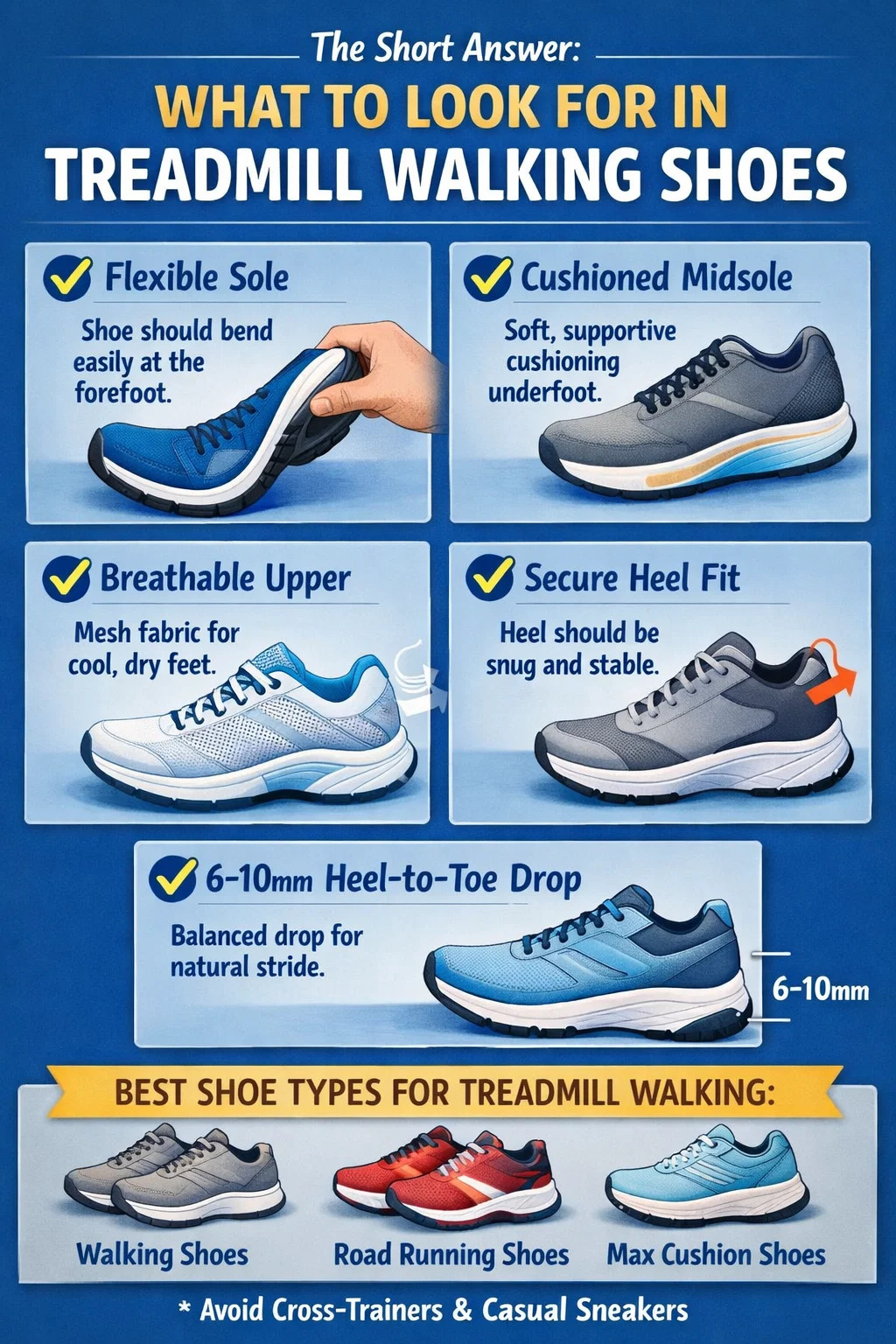
The best shoes for treadmill walking combine a flexible sole, adequate cushioning underfoot, and a snug but breathable upper. Unlike outdoor walking, treadmill walking places your feet on a consistent, flat, slightly cushioned belt — which changes what your shoes need to do. You don't need aggressive tread or thick waterproofing. What you do need is a shoe that flexes naturally with your foot strike, absorbs repetitive impact, and keeps your heel locked in place mile after mile.
Most podiatrists and sports medicine specialists recommend dedicated walking shoes or low-profile running shoes for treadmill use rather than cross-trainers or casual sneakers. The reason is simple: treadmill walking involves thousands of repetitive steps in exactly the same motion, and the wrong shoe can accelerate fatigue, cause blisters, or contribute to overuse injuries in the knees, hips, and lower back.
This guide breaks down exactly what features matter, which shoe types work best for different walkers, and how to match a shoe to your specific gait and foot shape — so your treadmill sessions are as comfortable and effective as possible.
It might seem like any comfortable shoe would work on a treadmill, but the mechanics of treadmill walking create a distinct set of demands. On a treadmill, the belt moves beneath your feet at a fixed pace, and your stride becomes more uniform and repetitive than it would be on varied outdoor terrain. This predictability is actually what makes the treadmill so useful for fitness — but it also concentrates stress on the same points of your foot and lower leg over and over again.
Several biomechanical factors distinguish treadmill walking from pavement or trail walking:
A 2019 study published in the Journal of Biomechanics found that treadmill walking at speeds between 2.5 and 4 mph produced lower ground reaction forces than overground walking at the same speed — confirming that the treadmill surface itself does some of the cushioning work. This means you may not need maximum-cushion shoes if you walk at moderate speeds, but you still need a shoe that supports a natural heel-to-toe rolling gait.
Heel-to-toe drop — the difference in thickness between the heel and forefoot of a shoe — is one of the most important specs for walkers, yet it's often overlooked. Walking is a heel-strike activity for most people: your heel contacts the belt first, then your weight rolls forward across the midfoot and toes. A shoe with too little drop (under 4mm) can strain your Achilles tendon and calves if you're used to traditional footwear. A shoe with too much drop (over 12mm) can push you onto your toes unnaturally.
For treadmill walking, most specialists recommend a heel-to-toe drop between 6mm and 10mm. This range supports a natural heel strike without forcing your ankle into an awkward plantarflexed position. Brands like New Balance, Brooks, and Saucony publish drop measurements openly; it's worth checking before buying.
The midsole is the foam layer between the outsole (bottom) and insole (top) of a shoe. It absorbs impact energy and determines how much "softness" you feel underfoot. For treadmill walking at a conversational pace (typically 2.5–3.5 mph), a medium-cushion midsole works well for most people. Very soft, maximally cushioned midsoles — like those in Hoka's Bondi series — are excellent for walkers with joint pain, arthritis, or plantar fasciitis, but can reduce ground feel and proprioception for those who don't need that level of protection.
Common midsole foam types and what they mean in practice:
The outsole of a treadmill walking shoe should flex easily through the forefoot. You can test this by holding the heel in one hand and the toe box in the other and bending the shoe — it should flex at roughly the ball-of-foot area, not the arch. Shoes that flex at the arch can stress the plantar fascia and contribute to foot fatigue.
Traction is less critical indoors than outdoors. You don't need deep lugs or aggressive rubber patterns for a treadmill belt. However, a completely slick outsole can actually cause micro-slipping on the belt, particularly at faster walking speeds. Look for shoes with a moderate, flat rubber outsole that grips the belt without feeling sticky or draggy.
Because treadmill walking happens in an enclosed, often heated space, your shoe's upper material matters more than it would outdoors. Mesh uppers — particularly engineered knit or open-weave mesh — allow airflow that significantly reduces moisture and heat buildup. Studies on athletic footwear comfort consistently find that foot temperature and moisture are among the top predictors of blister formation and perceived discomfort during extended exercise sessions.
Fit-wise, treadmill walking shoes should feel snug in the midfoot and heel but have a thumb's width of space between your longest toe and the front of the shoe. Feet swell slightly during exercise — typically by half a size over a 30-minute walk — so a shoe that fits perfectly while standing still may feel tight by the end of a session.
Not all athletic shoes are built equally for treadmill walking. Here's how different categories stack up:
| Shoe Type | Cushioning | Flexibility | Breathability | Treadmill Suitability |
|---|---|---|---|---|
| Dedicated Walking Shoes | Medium | High | Medium–High | Excellent |
| Road Running Shoes | Medium–High | High | High | Excellent |
| Max-Cushion Running Shoes | Very High | Medium | High | Good (for joint issues) |
| Cross-Trainers | Low–Medium | Low | Medium | Acceptable (short sessions) |
| Trail Running Shoes | Medium | Low | Medium | Poor |
| Casual Sneakers / Lifestyle Shoes | Low | Low | Low | Not Recommended |
Purpose-built walking shoes from brands like New Balance (the 928 and 847 series), Brooks (Addiction Walker), and Saucony (Echelon) are engineered specifically for heel-strike walking mechanics. They typically feature a slightly rounded heel to encourage smooth heel-to-toe rollthrough, extra depth in the toe box to prevent toe compression, and midsoles that are firmer underfoot than running shoes. For long treadmill walking sessions — anything over 45 minutes — this category generally delivers the best combination of support and comfort.
Many physical therapists and sports medicine physicians actually recommend road running shoes for treadmill walking, especially for walkers who move at brisk speeds (3.5 mph and above) or who plan to occasionally transition to jogging intervals. Road running shoes are optimized for forward motion, impact absorption, and breathability — all qualities that transfer well to treadmill use. Models in the neutral or mild stability category from Brooks (Ghost), ASICS (Gel-Kayano, Gel-Nimbus), New Balance (880), and Saucony (Ride) are widely used by recreational treadmill walkers. The key advantage over dedicated walking shoes is that running shoes typically use more modern foam technologies, resulting in lighter weight and better energy return.
Walkers managing knee osteoarthritis, hip replacement recovery, plantar fasciitis, or general lower-limb pain often benefit from maximum-cushion options. Hoka's Bondi and Clifton series are the most commonly recommended in this category. The Bondi, in particular, has a stack height of over 36mm and uses Hoka's EVA-based midsole to dramatically reduce impact transmission to the joints. A clinical study published in the British Journal of Sports Medicine found that maximum-cushion shoes reduced peak tibial acceleration — a proxy measure for impact on the lower leg — by approximately 18% compared to standard running shoes. For pain-free walking, that cushion differential is meaningful over a 60-minute session.
Your arch type and natural gait pattern should drive your shoe selection more than brand loyalty or aesthetics. Wearing a shoe that doesn't match your biomechanics — even an expensive, well-reviewed one — can create problems over time. Three primary foot types apply:
If your footprint shows a clear arch with moderate curve inward, you have a neutral foot type. Neutral walkers can wear the widest range of shoes. The best treadmill shoes for neutral feet are neutral-category road walking or running shoes with moderate cushioning and flexible forefoot construction. You don't need added arch support or motion-control features, which can feel restrictive and cause irritation if your foot naturally moves efficiently.
Low arches — sometimes called flat feet — cause the foot to roll inward excessively during the gait cycle (overpronation). On a treadmill, this inward collapse puts stress on the inner knee and hip over time. Walkers with low arches typically benefit from stability shoes, which have a firmer medial post (a denser foam wedge on the inner side of the midsole) to slow the rate of pronation. Brooks' Adrenaline GTS and ASICS' Gel-Kayano are long-standing benchmarks in this category. Some walkers with significant flat feet may also need custom orthotics — a recommendation best made by a podiatrist after a gait analysis.
High arches cause the foot to roll outward during walking — a motion called supination or underpronation. High-arched feet are generally more rigid and less effective at absorbing shock, so cushioning becomes the priority. Neutral shoes with maximum or enhanced cushioning serve high-arched walkers best. Stability features or motion-control elements should be avoided, as they resist inward motion and can amplify the outward lean of a supinating foot.
A quick way to assess your arch type without a specialist is the wet test: wet your foot, step on a piece of cardboard or paper bag, and examine the imprint. A full footprint with no arch curve visible indicates a low arch; a thin connection between heel and forefoot indicates a high arch; a moderate curve inward is a neutral arch. For definitive assessment, many specialty running stores offer free video gait analysis on their in-store treadmills — worth doing before spending over $100 on footwear.
Rather than recommending a single "best" shoe, it's more useful to match options to common treadmill walker profiles:
Shoe lifespan is often underestimated, and worn-out shoes are a common but overlooked source of foot and knee discomfort. General guidelines from orthopedic and sports medicine specialists suggest replacing athletic shoes every 300 to 500 miles, with walking shoes typically lasting toward the higher end of that range because the impact forces of walking are lower than running.
To put that in practical terms: if you walk 3 miles on the treadmill five days per week, that's roughly 15 miles per week, or 780 miles per year. At the 400-mile mark, you'd be replacing your shoes approximately every 6 months. The outsole rubber often looks fine at that point — the degradation happens invisibly in the midsole foam, which compresses over time and loses its shock-absorbing properties.
Signs that your treadmill walking shoes need replacing:
One practical strategy is to keep a dedicated pair of treadmill-only shoes that never get worn outdoors. Outdoor surfaces — especially asphalt and concrete — wear outsole rubber and contaminate the upper with debris faster than treadmill use alone. Shoes used exclusively on the treadmill can last 20–30% longer by mileage.
Many people select shoes based on how they feel standing still in the store — and a shoe that feels great on carpet may feel completely different during 40 minutes of heel-striking on a moving belt. If possible, try shoes on a demo treadmill before buying, or purchase from a retailer with a generous return policy (REI's year-round return policy and many running specialty stores' 30-day wear trials are worth using for this purpose).
Cross-trainers are designed for lateral movement — side shuffles, aerobics, weightlifting — and are deliberately stiffer to provide side-to-side stability. That stiffness works against you on the treadmill, where you need forward flex and cushioning. Using cross-trainers for long treadmill walks is a bit like using a hiking boot for a road marathon: technically possible, but you'll pay for it in fatigue and discomfort.
Most casual buyers assume standard (D for men, B for women) width is correct, but a significant percentage of adults — particularly those over 50, those with bunions, or those with naturally wide forefeet — walk in shoes that are too narrow. A too-narrow toe box compresses the toes, contributes to bunions and hammer toe progression, and creates the blisters and black toenails often blamed on treadmill use. New Balance, Brooks, ASICS, and Saucony all offer extended width options (2E, 4E for men; D, 2E for women). It's worth measuring your foot width at a specialty store at least once.
The psychological comfort of a broken-in shoe is real, but structurally compromised footwear is a leading contributor to overuse injuries. A shoe that's passed its mileage threshold feels soft and familiar precisely because the foam has permanently compressed — which means it's no longer absorbing impact the way it should. If your knees or feet have started aching on the treadmill, consider whether your shoes are past their useful life before looking for other causes.
Most well-made treadmill walking shoes come with adequate stock insoles for the average foot. However, aftermarket insoles can significantly improve comfort and support in specific situations:
Custom orthotics — prescribed and cast by a podiatrist — are warranted for walkers with structural foot abnormalities, chronic plantar fasciitis unresponsive to other interventions, or significant leg-length discrepancies. They typically cost between $300 and $600 out of pocket but are often partially covered by health insurance. For the majority of treadmill walkers, however, a well-fitted shoe with appropriate arch support will provide everything needed without custom insoles.
Even the best treadmill walking shoe underperforms if paired with the wrong socks. Cotton socks — despite being comfortable at rest — absorb moisture and hold it against the skin. During a 45-minute treadmill walk, feet can generate enough sweat to soak a cotton sock completely, dramatically increasing friction and blister risk. Moisture-wicking athletic socks made from merino wool, nylon, or synthetic blends maintain a drier foot environment and reduce hot spots.
Sock thickness also affects fit: a shoe fitted while wearing thin dress socks may feel loose with thick cushioned athletic socks. It's worth bringing your intended socks when trying on treadmill shoes, and selecting a sock thickness consistent with what you'll wear for your sessions.
Toe-separator socks (like those from Injinji) are anecdotally useful for walkers prone to blisters between the toes, as they eliminate skin-on-skin friction in the toe box without requiring a wider shoe.
Yes — road running shoes are actually one of the best options for treadmill walking, particularly if you walk briskly or mix in jogging intervals. They're designed for forward motion, have excellent cushioning and breathability, and use modern foam technologies that hold up well over time. Avoid trail running shoes, which have aggressive lugs and stiffer platforms designed for off-road terrain.
Many experienced walkers and runners do choose athletic shoes a half size larger than their casual shoe size. This accounts for foot swelling during exercise and ensures the toe box doesn't compress the toes at the end of a long walk. As a general rule, there should be about a thumb's width of space between your longest toe and the front of the shoe when standing. If your toes are touching or nearly touching the front, go up half a size.
It's not harmful, but it does reduce shoe lifespan. Outdoor surfaces — asphalt, concrete, gravel — wear outsole rubber significantly faster than treadmill belts. Keeping a dedicated pair of treadmill shoes extends how long they last and keeps the sole free from debris that can scratch your treadmill belt over time.
Older walkers generally benefit from shoes with maximum cushioning (to compensate for naturally thinning heel fat pads), wider toe boxes (bunions and toe spreading become more common with age), easy slip-on or Velcro closure options for those with reduced hand dexterity, and stable midsoles with moderate structure to support joints with reduced cartilage. Hoka's Bondi (wide option available), New Balance's 928v3, and Brooks' Addiction Walker are frequently recommended by podiatrists for senior treadmill walkers.
If knee pain begins or worsens after starting treadmill walking and you haven't changed your workout volume, your shoes are worth examining first. Key questions: Are they worn past 400 miles? Are they the right stability category for your gait (a neutral shoe on an overpronating foot can cause medial knee stress)? Do you feel your ankle collapsing inward when you walk? If you're unsure, a gait analysis at a running specialty store is free at most locations and can identify mismatches between your foot mechanics and current shoe.
Hot Products

Phone: +86-152 5836 5876
TEL: +86-574 6322 1199
Email: mandy@evbfit.com
Address: No. 518 Zhengtong Road, Kandun Street, Cixi, Ningbo, Zhejiang, China
Copyright © Zhejiang Everbright Industry, Inc. All Rights Reserved. Custom Exercise Bikes Manufacturers China Stationary Bikes Factory