Mar 30, 2026
Content
Yes, you can watch TV while walking on a treadmill — and for most people, it's a perfectly safe and even beneficial habit. The key qualifier is walking, not running. At a moderate walking pace of 2.5 to 3.5 mph, dividing your attention between the screen and your stride carries minimal risk and can dramatically improve how consistently you show up for your workouts. That said, there are nuances worth understanding before you prop your tablet against the console and hit play.
This article breaks down the science, the practical trade-offs, the situations where watching TV on a treadmill helps versus hurts, and how to set up your space so you're getting real fitness value — not just logging steps while zoning out.
Treadmill walking is repetitive. There's no changing terrain, no social interaction, no new scenery — just the hum of a belt and the clock ticking. Research published in the journal Medicine & Science in Sports & Exercise found that perceived exertion drops significantly when people are distracted during steady-state cardio, which means the same workout feels easier when you're engaged with something else. That's not a placebo effect — it reflects how the brain allocates attentional resources.
From a behavioral standpoint, pairing a desired activity (watching your favorite show) with a neutral or mildly unpleasant one (exercising) is a strategy known as "temptation bundling," a term popularized by behavioral economist Katherine Milkman. In her studies, participants who could only listen to audiobooks during gym sessions worked out 51% more frequently than the control group. The same principle applies to TV on a treadmill.
The practical upshot: if watching TV is what gets you on the treadmill four times a week instead of twice, it's contributing meaningfully to your health — even if the workout is less intense than it might otherwise be.
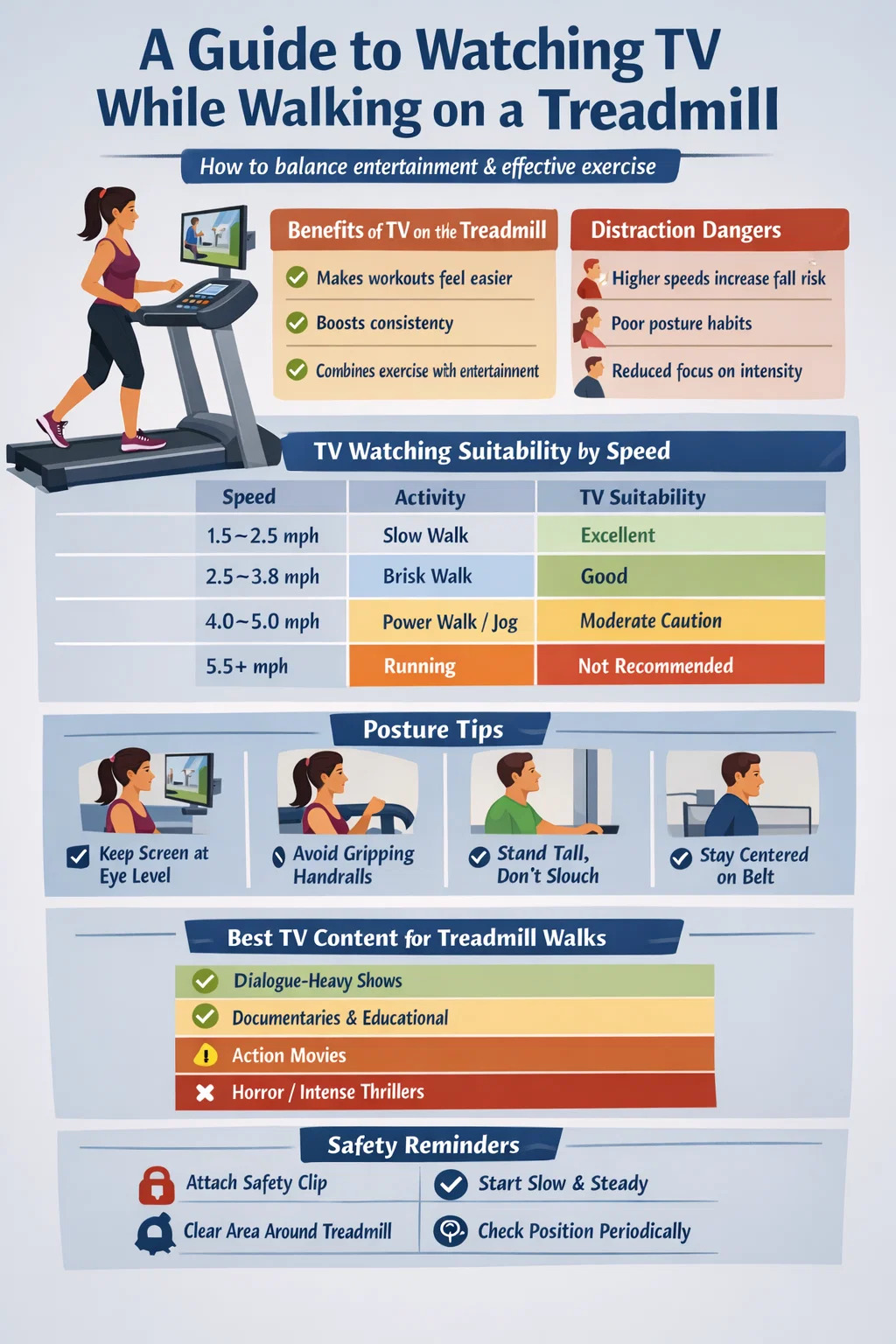
The appropriateness of watching TV depends heavily on your treadmill speed and the nature of the workout. Here's a straightforward breakdown:
| Speed Range | Activity Type | TV Watching Suitability | Notes |
|---|---|---|---|
| 1.5 – 2.5 mph | Slow / Recovery Walk | Excellent | Minimal coordination demand; very safe |
| 2.5 – 3.8 mph | Brisk Walk | Good | Sweet spot for most casual viewers |
| 4.0 – 5.0 mph | Power Walk / Jog | Moderate caution | Glance away briefly, but stay alert |
| 5.5+ mph | Running | Not recommended | Balance and gait need full attention |
The transition point where distraction becomes a genuine risk is roughly around 4.5 mph for most untrained individuals. At that pace, your stride frequency and arm swing require more active neuromuscular coordination, and a momentary lapse in attention — say, leaning forward to catch a subtitle — can cause a stumble or an awkward foot placement.
Incline also plays a role. Walking at a 5% incline at 3.0 mph demands more postural stability than flat walking at the same speed. If you're doing incline treadmill training, it's worth being more conservative about how engaged you are with the screen.
This is where things get more nuanced. The answer is: it depends on your goal.
Walking at 3.0 mph for 45 minutes burns roughly 150–200 calories for a 155-pound person, regardless of whether you're watching TV or not. The metabolic cost of walking at a fixed speed on a treadmill doesn't change based on what you're looking at. So from a pure energy-expenditure standpoint, TV has little effect on outcome — unless distraction causes you to slow down, reduce incline, or cut the session short.
One study from the University of Vermont found that exercisers who watched TV during moderate-intensity cardio actually exercised for longer durations on average compared to those who didn't, which led to greater total calorie expenditure despite the lower perceived engagement per minute.
Here's the honest trade-off: distraction tends to keep you in a comfortable, flat-effort zone. You're less likely to push through a sprint interval, respond to your body's cues to increase pace, or stay mentally engaged with your breathing and form. High-intensity interval training (HIIT) on a treadmill, structured tempo runs, and progressive incline protocols all benefit from deliberate focus. Watching a drama series while doing these is counterproductive — not dangerous, but it dilutes the training stimulus.
TV wins, without question. The biggest predictor of fitness progress is showing up repeatedly over weeks and months. If watching TV is what makes that happen, it's the right call for the majority of people who struggle with exercise adherence.
One genuine concern with watching TV on a treadmill — often overlooked in casual advice — is the effect on posture. When people crane their necks toward a screen that's positioned at the wrong height, or lean on the handrails to stay stable while their eyes track dialogue, form degrades in subtle but compounding ways.
These aren't reasons to avoid TV entirely — they're reasons to set up your screen properly and check in on your posture every 10 minutes or so.
Getting the physical setup right makes a significant difference in both safety and enjoyment. Here's what to aim for:
The ideal screen height places the center of the TV at roughly eye level or just slightly below — the same principle used for ergonomic computer monitor placement. This keeps your neck neutral. If you're using a wall-mounted TV, check that you don't have to crane upward more than 10–15 degrees. A tablet or phone on a treadmill desk arm is easier to optimize for height.
Distance matters too. For a 40-inch TV, a viewing distance of 5–7 feet is comfortable without requiring squinting. If you're closer than 4 feet, you'll be using more eye movement to track the screen, which can cause fatigue.
Treadmill belts are noisy — typically 60–75 decibels at walking speed, similar to a busy restaurant. To hear your show clearly, you have two practical options: use wireless headphones (over-ear or earbuds) or enable subtitles. Raising TV volume to compete with belt noise often pushes sound to uncomfortable levels, and prolonged exposure above 85 dB carries hearing risk.
Subtitles are an underrated option. They let you watch at low or zero volume, which also keeps the treadmill room usable for others in the household. Many people report that following subtitles keeps them more engaged with the content, which extends workout duration.
If you're using a treadmill desk — a workstation mounted over a slow-walking treadmill — a tablet holder or monitor arm is the standard solution. These attach to the treadmill frame or the desk surface and allow precise height and angle adjustment. Good options start at around $25 for basic phone/tablet mounts and go up to $150+ for articulating monitor arms.
If your treadmill is positioned where bright light hits the TV screen — sunlight through a window, overhead gym lighting — you'll find yourself squinting or leaning toward the screen. Anti-glare screen protectors for TVs and tablets help, as does adjusting treadmill position relative to light sources before you commit to a permanent setup.
Not all content is equally suited for treadmill viewing. The goal is material that's engaging enough to pass the time, but not so visually demanding that you're constantly craning forward or losing awareness of your body.
Some people find that using their treadmill session as a dedicated viewing window for one specific show — one they only watch while exercising — creates a powerful behavioral loop. You want to watch the show, so you get on the treadmill. You're on the treadmill, so you watch the show. This is the temptation bundling strategy mentioned earlier, applied deliberately.
Even at walking speeds, treadmills carry real injury risk when attention lapses. The Consumer Product Safety Commission estimates over 22,000 treadmill-related injuries occur annually in the United States, with a meaningful portion attributed to distraction. Here are the safety habits that matter most:
A growing subset of treadmill users isn't watching TV for entertainment — they're watching video calls, working through video lectures, or reviewing presentations while walking. Treadmill desks, which support a laptop or monitor over a slow-speed walking treadmill (typically 1.0–2.5 mph), have been adopted in offices and home setups precisely because light walking doesn't significantly impair cognitive performance.
Research from the Mayo Clinic found that using a treadmill desk at 1.5 mph for 2–3 hours per workday could burn an additional 100–130 calories per hour compared to sitting, without meaningfully affecting typing accuracy or reading comprehension. For knowledge workers who spend most of their day sedentary, this represents a meaningful long-term metabolic benefit.
The trade-off is that fine motor tasks like precise mouse work or detailed graphic design are harder at even 1.5 mph. Reading and watching video content, however, translates well to treadmill desk speeds.
While walking on a treadmill while watching TV is safe for most healthy adults, some groups should approach it with more caution:
If you're going to watch TV while walking on a treadmill, here are habits that help you get more out of both the exercise and the viewing experience:
Watching TV while walking on a treadmill is not just acceptable — for many people, it's the strategy that makes a consistent walking habit realistic. The research and practical evidence both support it as a tool for extending workout duration, improving adherence, and making movement feel less like a chore.
The nuances worth respecting: keep speeds in the walking range rather than running, position your screen at eye level, don't use the handrails as a crutch, and match your content type to your session intensity. If you're doing a purposeful fitness workout aimed at pushing your cardiovascular limits, save the TV for another time. But for the daily movement practice most people need more of? Put on your show, attach the safety clip, and walk.
Hot Products

Phone: +86-152 5836 5876
TEL: +86-574 6322 1199
Email: mandy@evbfit.com
Address: No. 518 Zhengtong Road, Kandun Street, Cixi, Ningbo, Zhejiang, China
Copyright © Zhejiang Everbright Industry, Inc. All Rights Reserved. Custom Exercise Bikes Manufacturers China Stationary Bikes Factory