Apr 06, 2026
Content
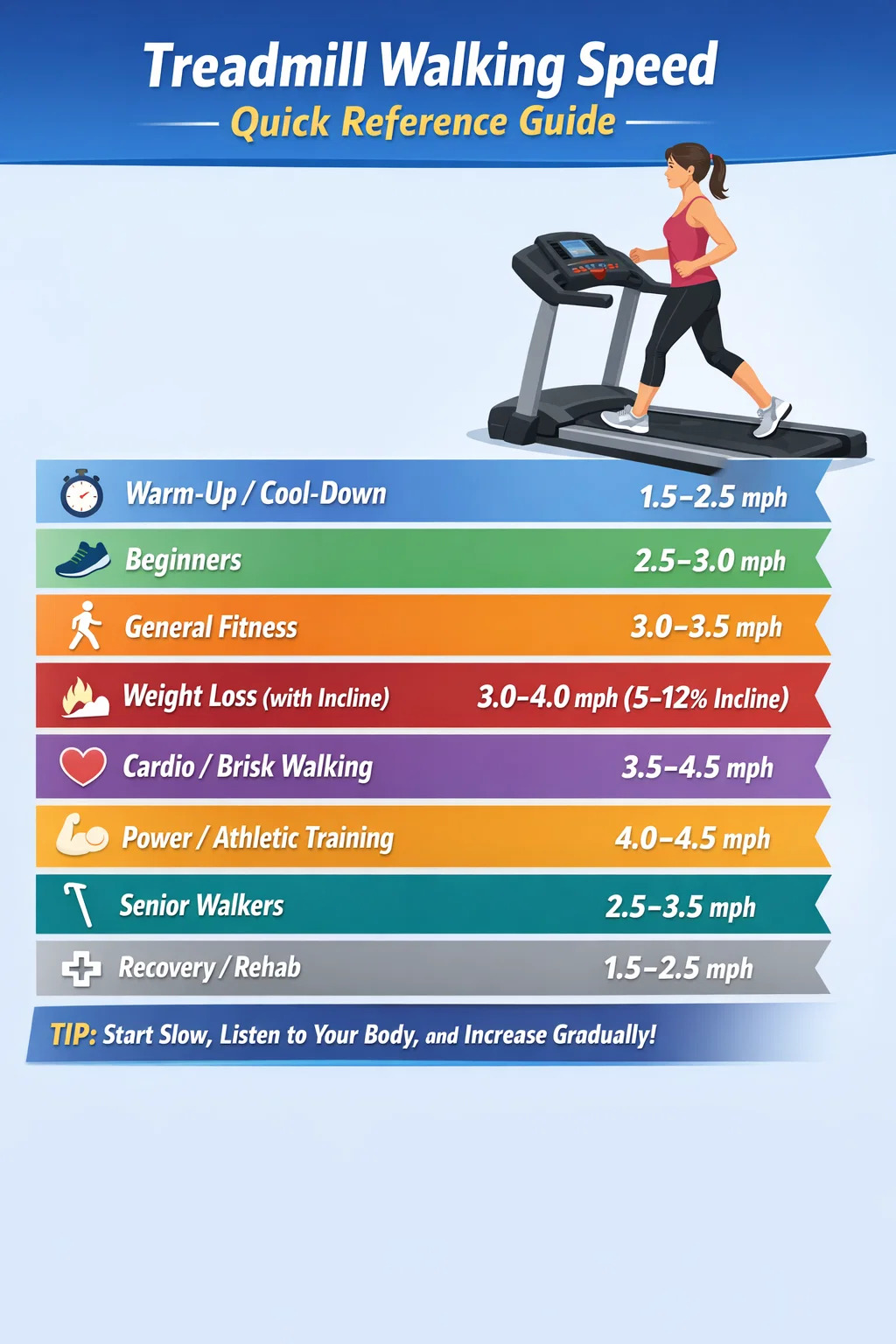
For most adults, a good walking speed on a treadmill falls between 2.5 and 4.0 mph (4.0–6.4 km/h). This range covers everything from a relaxed stroll to a brisk, purposeful pace that elevates your heart rate without breaking into a jog. If you want a single number to start with, 3.0 to 3.5 mph is widely considered the sweet spot for healthy adults looking to stay active, burn calories, and improve cardiovascular health.
That said, the "right" speed depends heavily on your age, fitness level, body weight, and what you're trying to achieve. A 25-year-old training for a 5K has very different needs than a 65-year-old recovering from a knee injury. The sections below break down optimal treadmill walking speeds for every situation, along with hard data on calorie burn, heart rate targets, and how to structure your sessions for real results.
Treadmill speed is displayed in miles per hour (mph) in the United States and kilometers per hour (km/h) in most other countries. Here's a quick reference for how different speeds translate into real-world effort:
| Speed (mph) | Speed (km/h) | Pace (min/mile) | Effort Level |
|---|---|---|---|
| 2.0 | 3.2 | 30:00 | Very slow / recovery |
| 2.5 | 4.0 | 24:00 | Easy / beginner |
| 3.0 | 4.8 | 20:00 | Moderate / everyday walk |
| 3.5 | 5.6 | 17:08 | Brisk / fitness walking |
| 4.0 | 6.4 | 15:00 | Fast walk / power walking |
| 4.5 | 7.2 | 13:20 | Very fast / race walking |
Most people naturally transition from walking to jogging somewhere around 4.5 to 5.0 mph. Anything above that on a treadmill is generally considered a jog or run, not a walk. So if your goal is purely walking-based fitness, keeping the speed at or below 4.5 mph makes mechanical sense for your body.
Speed alone doesn't define a great treadmill walking workout. Your goal shapes what "good" actually looks like. Below are target speed ranges based on common fitness objectives.
To burn fat efficiently while walking on a treadmill, aim for 3.0 to 4.0 mph at a 5–10% incline. The incline is key here. Research published in the Journal of Sports Science shows that walking at 3.5 mph on a 5% grade burns approximately the same number of calories as jogging on a flat surface — without the joint stress. A 155-pound (70 kg) person walking at 3.5 mph for 60 minutes burns roughly 300–350 calories. Add a 5% incline and that figure jumps to around 400–450 calories for the same duration.
Staying in the fat-burning zone (typically 60–70% of your maximum heart rate) is easier to maintain for longer durations at walking speeds. For a 40-year-old with a max heart rate of around 180 bpm, that means targeting 108–126 bpm during your treadmill walk.
The American Heart Association recommends at least 150 minutes of moderate-intensity aerobic activity per week. On a treadmill, "moderate intensity" for walking means 3.5 to 4.5 mph — fast enough to raise your heart rate and breathing noticeably, but still allowing you to hold a conversation. This is sometimes called the "talk test" pace.
Consistent brisk walking at this range has been linked to lower blood pressure, improved cholesterol levels, and reduced risk of type 2 diabetes. A Harvard study tracking over 72,000 female nurses found that those who walked briskly for 30 minutes most days reduced their risk of heart disease by 30–40% compared to sedentary women.
If you're walking on a treadmill simply to stay active, hit step goals, or break up a sedentary workday, 2.5 to 3.5 mph is perfectly appropriate. This covers casual movement, light exercise, and desk treadmill use. Many under-desk treadmill setups operate best in the 1.5–3.0 mph range due to workspace constraints, though fitness benefits are modest at the lower end.
Athletes using treadmill walking as active recovery or low-impact cross-training often work in the 3.5 to 4.5 mph range at steep inclines (10–15%). The incline treadmill walk — sometimes called the "12-3-30" method (12% incline, 3.0 mph, 30 minutes) — has gained popularity online for its high calorie output and low injury risk. At a 12% incline and 3.0 mph, most people will hit 70–80% of their maximum heart rate, which crosses into vigorous-intensity territory despite the relatively modest speed.
Natural walking speed declines with age. Studies tracking average human gait speed show that adults in their 20s and 30s tend to walk at 3.3–3.5 mph naturally, while adults in their 60s and 70s average closer to 2.7–3.0 mph. This matters on a treadmill because "brisk" is relative — what challenges a 30-year-old may be unnecessarily stressful for a 70-year-old, or laughably easy for a trained athlete.
| Age Group | Beginner (mph) | Moderate (mph) | Brisk / Challenging (mph) |
|---|---|---|---|
| 18–30 | 2.5–3.0 | 3.0–3.8 | 3.8–4.5 |
| 31–45 | 2.5–3.0 | 3.0–3.5 | 3.5–4.5 |
| 46–60 | 2.0–2.8 | 2.8–3.5 | 3.5–4.0 |
| 61–75+ | 1.5–2.5 | 2.5–3.0 | 3.0–3.8 |
These ranges assume no significant injury or health limitation. Always consult a physician before starting a new exercise program if you have cardiovascular, orthopedic, or other chronic health conditions.
One of the biggest mistakes people make on a treadmill is focusing only on speed while ignoring incline. Incline dramatically changes the intensity of a walk without requiring you to go faster. Here's why this matters: walking at 3.0 mph on a flat treadmill burns around 240 calories per hour for a 155 lb person. The same person walking at 3.0 mph on a 10% incline burns closer to 450 calories per hour — nearly double, at the same speed.
Incline also activates different muscle groups. Flat treadmill walking primarily engages the quads and calves. Add incline and you recruit significantly more glutes, hamstrings, and hip flexors. For anyone focused on lower-body toning or building functional strength, incline walking is far more productive than simply walking faster on a flat surface.
A common guideline among fitness coaches is to set the treadmill at a minimum 1% incline during all walking sessions. This compensates for the lack of air resistance indoors, making the effort more closely match outdoor walking. At 0% incline, treadmill walking is slightly easier than walking outside at the same speed because the belt assists leg turnover. The 1% correction accounts for this difference and produces more accurate calorie and effort estimates.
Numbers and charts can only take you so far. The real measure of whether your treadmill walking speed is appropriate comes from how your body responds during and after the session. Here are four reliable methods:
If you can speak in full sentences without gasping, you're at a light-to-moderate intensity. If you can say a few words but need to pause for breath, you're in the moderate-to-vigorous zone. If you can barely speak at all, you've crossed into vigorous territory. For a brisk walking workout aimed at cardiovascular health, the "a few words" level is your target.
Use the formula 220 minus your age to estimate your maximum heart rate. Then aim for the following zones depending on your goal:
A 50-year-old has an estimated max HR of 170 bpm. For a fat-burning treadmill walk, they'd target 102–119 bpm. Most smartwatches and fitness trackers can provide real-time heart rate data, making this easy to monitor mid-session.
The Rate of Perceived Exertion (RPE) scale runs from 1 (no effort) to 10 (maximum effort). A good treadmill walking workout should feel like a 5–6 out of 10 — noticeable effort, slightly elevated breathing and heart rate, but sustainable for 30–60 minutes. If you're at a 3 or below, you need to increase speed or incline. If you're at an 8 or above while walking, slow down or reduce incline to avoid injury.
After a moderate treadmill walk, your breathing and heart rate should return to near-normal within 5–10 minutes. If it takes longer than 15 minutes, the session may have been too intense. If you feel fully recovered within 2 minutes, it was likely too easy. These self-assessments give more nuanced feedback than any speed chart alone.
If you're new to treadmill exercise, starting too fast is one of the most common mistakes. It leads to poor form, early fatigue, and a higher risk of missteps or falls on the belt. Begin at 2.0–2.5 mph for the first 5 minutes as a warm-up regardless of your fitness level, then gradually increase to your working pace.
A beginner 4-week progression plan might look like this:
By week four, most beginners are walking at a legitimate brisk pace and logging 140+ minutes of moderate activity per week — right in line with health authority guidelines. From there, the goal shifts to either increasing duration, bumping up incline, or adding interval variations to keep progressing.
Steady-state walking at a fixed speed has clear benefits, but alternating between slower and faster speeds — known as interval walking — can significantly improve outcomes. Studies from the Mayo Clinic and other institutions show that interval training burns more calories per unit of time and improves cardiovascular fitness more efficiently than sustained moderate exercise at the same average intensity.
A simple treadmill interval walking session might look like this:
This structure takes about 35–40 minutes and is manageable for intermediate walkers. Total calorie burn for a 155 lb person using this protocol runs approximately 320–380 calories — more efficient than 40 minutes of walking at a steady 3.0 mph (roughly 200–240 calories).
You can also vary incline rather than speed: walk at 3.0 mph for 2 minutes at 1% incline, then bump to 8% incline for 2 minutes at the same speed, and repeat. This is gentler on joints than speed intervals while still providing a meaningful cardiovascular stimulus.
Calorie expenditure during treadmill walking depends on body weight, speed, incline, and session duration. The table below shows estimated calories burned per 30 minutes for three common body weights at varying walking speeds on a flat surface:
| Speed (mph) | 130 lb / 59 kg | 155 lb / 70 kg | 185 lb / 84 kg |
|---|---|---|---|
| 2.5 mph | ~97 cal | ~116 cal | ~138 cal |
| 3.0 mph | ~118 cal | ~140 cal | ~167 cal |
| 3.5 mph | ~140 cal | ~167 cal | ~200 cal |
| 4.0 mph | ~162 cal | ~193 cal | ~230 cal |
| 4.5 mph | ~180 cal | ~215 cal | ~256 cal |
These are estimates based on MET (Metabolic Equivalent of Task) values from the Compendium of Physical Activities. Individual variation can be significant — fitness trackers and treadmill displays can overestimate calorie burn by 15–20%, so treat these figures as useful ballparks rather than exact counts.
Speed settings are meaningless if your form breaks down. Several habits common to treadmill users undercut the effectiveness of their workouts, regardless of what number is displayed on the console.
Gripping the side rails while walking is probably the single most counterproductive treadmill habit. It allows people to run a much higher incline or speed than their fitness level actually supports, while simultaneously reducing calorie burn by 20–25% and shifting the body into a posture that stresses the wrists, shoulders, and lower back. Let go of the rails and find a speed you can maintain with good posture and free-swinging arms. Your arms should move naturally at your sides — bent at roughly 90 degrees.
Many treadmill walkers stare at the moving belt beneath their feet, which drops the chin toward the chest and creates a forward hunch. Over 30–60 minutes, this compresses the cervical spine and reduces breathing efficiency. Keep your gaze level — looking at a screen, window, or a point on the wall ahead of you — and your chin parallel to the floor.
Taking excessively long steps to match a faster treadmill speed — instead of letting your cadence naturally increase — puts undue stress on the knees and hip flexors. Your foot should land beneath your center of gravity, not far out in front of it. If you feel yourself reaching forward with each step, the speed is too fast for your current fitness level.
Jumping straight to your peak walking speed from a standing start shocks the cardiovascular system and cold muscles. Spend the first 3–5 minutes gradually increasing from 1.5–2.0 mph to your target speed. Similarly, spend the last 3–5 minutes decelerating back to 1.5–2.0 mph. This simple practice reduces post-exercise soreness and lowers the risk of dizziness when stepping off the belt.
The body adapts to repeated stress remarkably fast. What felt challenging at 3.0 mph after two weeks may feel comfortable and easy after six. To keep making fitness gains, you need to apply progressive overload — gradually increasing the challenge placed on your cardiovascular system and muscles.
A practical approach is to apply the 10% rule: never increase your weekly walking volume (total time or total distance) by more than 10% per week. This applies to speed increments as well. If you've been comfortable at 3.0 mph for two weeks, try 3.3 mph. If that feels easy after two more weeks, move to 3.5 mph. Small, consistent increases over months produce substantial long-term results.
Another strategy is to periodize your walking workouts — alternating between speed-focused sessions (higher mph, flat) and endurance-focused sessions (longer duration, lower speed but higher incline). This keeps the body guessing and prevents the plateau effect that hits many treadmill walkers within the first two months of consistent training.
Not exactly. Treadmill walking and outdoor walking are similar but not identical in terms of physical demand. On a treadmill, the moving belt assists with leg turnover, meaning you do slightly less muscular work to maintain the same speed compared to walking on pavement or a trail. Wind resistance — even at normal walking speeds — also adds to the effort of outdoor walking in a way that's absent on a treadmill.
Research suggests that setting a 1% treadmill incline approximately equalizes the effort between treadmill and outdoor walking at moderate speeds (up to 7 km/h or 4.3 mph). At higher speeds, a slightly steeper incline may be needed to fully replicate outdoor exertion.
There's also the terrain variable: outdoor walking involves constant micro-adjustments in balance, stride, and foot placement that engage stabilizer muscles the treadmill doesn't activate. This doesn't mean treadmill walking is inferior — it has real advantages in controllability, weather independence, and joint-friendly cushioning — but it does mean that exclusively treadmill-trained walkers may notice a difference if they transition to outdoor terrain for longer distances.
To summarize everything above in one place:
Start at the lower end of your applicable range, use the talk test and perceived exertion to fine-tune, and progress gradually over weeks rather than days. The best treadmill walking speed is the one that challenges you just enough to drive adaptation without pushing into discomfort, pain, or unsustainable effort. Consistency over months will always deliver better results than occasional bursts at maximum intensity.
Hot Products

Phone: +86-152 5836 5876
TEL: +86-574 6322 1199
Email: mandy@evbfit.com
Address: No. 518 Zhengtong Road, Kandun Street, Cixi, Ningbo, Zhejiang, China
Copyright © Zhejiang Everbright Industry, Inc. All Rights Reserved. Custom Exercise Bikes Manufacturers China Stationary Bikes Factory