Apr 13, 2026
Content
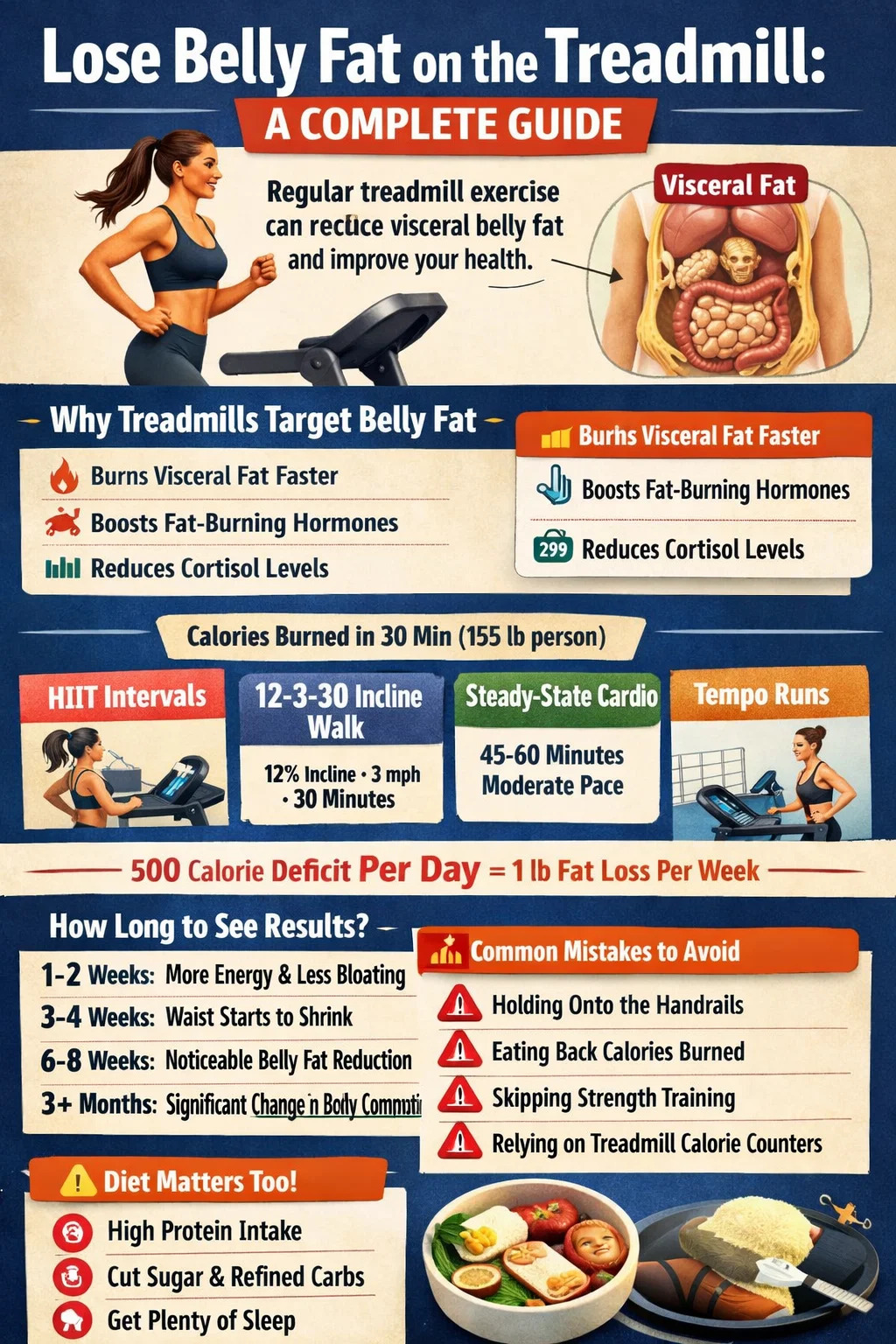
Yes, you can absolutely lose belly fat on a treadmill — but the answer comes with important context. A treadmill alone will not spot-reduce fat from your stomach. No exercise can do that. What a treadmill does is burn calories, and when you consistently burn more calories than you consume, your body draws on stored fat for energy — including the fat around your abdomen. Studies consistently show that aerobic exercise, including treadmill running and walking, is one of the most effective tools for reducing visceral fat, which is the deep abdominal fat wrapped around your organs and linked to metabolic disease.
A 2012 study published in the American Journal of Physiology found that aerobic exercise reduced visceral fat by nearly 7% over 8 months without dietary changes, outperforming resistance training alone for abdominal fat loss. That is significant. It means climbing onto a treadmill regularly, with the right approach, genuinely moves the needle on belly fat — not just overall weight.
This article breaks down exactly how treadmill workouts drive belly fat loss, what workouts work best, how long it takes, and what mistakes most people make that slow or stop results entirely.
Belly fat — particularly visceral fat — is metabolically active. That means it responds more readily to energy deficit than subcutaneous fat (the fat just under the skin on your arms, thighs, or buttocks). When you engage in sustained aerobic activity like treadmill running or brisk walking, your body releases catecholamines, stress hormones including adrenaline and noradrenaline, which mobilize fatty acids from fat stores. Visceral fat has a higher density of beta-adrenergic receptors, making it more sensitive to these hormones.
In plain terms: your body preferentially burns visceral belly fat during prolonged aerobic sessions because it is easier to access. This is why regular treadmill cardio shows measurable reductions in waist circumference even in studies where total body weight loss is modest.
Research from Duke University found that participants who did 30 minutes of moderate jogging 5 days per week lost significantly more visceral fat than those doing resistance training, despite similar calorie burns. The aerobic component was the deciding factor.
Beyond hormonal mechanisms, sustained treadmill exercise also lowers baseline cortisol levels over time. Chronically elevated cortisol — driven by poor sleep, stress, or sedentary behavior — is one of the primary drivers of visceral fat accumulation. Regular aerobic exercise directly counteracts this process.
Calorie burn on a treadmill depends on body weight, speed, incline, and duration. To lose belly fat, you need a consistent calorie deficit — and understanding what your treadmill sessions actually contribute is essential for setting realistic expectations.
| Activity | Speed | Calories/30 min (155 lb person) | Calories/30 min (185 lb person) |
|---|---|---|---|
| Slow walk | 2.5 mph | ~107 | ~128 |
| Brisk walk | 3.5 mph | ~149 | ~178 |
| Light jog | 5 mph | ~223 | ~266 |
| Running | 6.5 mph | ~298 | ~355 |
| Fast running | 8.5 mph | ~372 | ~444 |
| Incline walk (10%) | 3.5 mph | ~223 | ~266 |
One pound of fat equals approximately 3,500 calories. To lose one pound per week, you need a daily deficit of 500 calories. Combining treadmill sessions burning 300–400 calories with modest dietary adjustments — eliminating one sugary drink, reducing portion size slightly — makes this entirely achievable without extreme measures.
Incline walking deserves special mention. Walking at a 10–15% incline at 3–4 mph burns nearly as many calories as flat jogging, while placing far less impact stress on your joints. For beginners, heavier individuals, or those with knee issues, incline treadmill walking is often the smarter starting point — and it is a legitimate fat-burning strategy, not a shortcut.
Not all treadmill sessions produce the same fat-loss results. The type, intensity, and structure of your workouts matter significantly. Here are the most effective approaches, each backed by research and real-world outcomes.
HIIT alternates short bursts of near-maximum effort with recovery periods. On a treadmill, this might look like 30 seconds at 8–9 mph followed by 90 seconds at 3.5 mph, repeated for 20–25 minutes. Multiple studies confirm HIIT produces significantly greater reductions in abdominal fat than steady-state cardio for equivalent time investment.
A meta-analysis published in Obesity Reviews found that HIIT reduced waist circumference by an average of 2 cm more than moderate-intensity continuous exercise when matched for duration. The key mechanism is excess post-exercise oxygen consumption (EPOC) — your body continues burning calories at an elevated rate for hours after a HIIT session.
A sample beginner HIIT treadmill session:
Total time: approximately 25–30 minutes. Calorie burn rivals a 45-minute steady jog, with higher fat oxidation after the session ends.
Running or jogging at a consistent pace in the 60–70% of your maximum heart rate zone for 45–60 minutes is a reliable fat-burning strategy. At this intensity, your body relies more heavily on fat as a fuel source compared to glycogen. The practical target heart rate for most adults in this zone is approximately 120–140 beats per minute.
For someone new to running, this might mean a brisk walk at 4 mph on flat ground or a moderate jog at 5–5.5 mph. For more experienced runners, it corresponds to a comfortable pace where you can hold a conversation but feel genuinely challenged. Consistency across weeks and months is what drives the cumulative calorie deficit necessary for visible belly fat reduction.
This approach has gained substantial popularity — often called "12-3-30" (12% incline, 3 mph, 30 minutes) — and the attention is warranted. At a 12% incline and 3 mph, calorie expenditure approximates that of flat jogging at 5 mph, while the impact on joints is far lower. The posterior chain — glutes, hamstrings, calves — works much harder than on flat ground, adding a muscle-building stimulus alongside the fat-burning cardio effect.
This protocol is particularly effective for people who are carrying excess weight, recovering from injury, or simply find running unsustainable. Done 4–5 days per week, it delivers a meaningful weekly calorie deficit without the joint stress or recovery demands of running.
A tempo run is performed at a "comfortably hard" pace — roughly 80–85% of maximum heart rate — sustained for 20–40 minutes. This is harder than jogging but not a sprint. Tempo running burns a high number of calories per minute, improves cardiovascular efficiency, and elevates your metabolic rate for longer after the session. For those already capable of jogging comfortably, adding one tempo run per week can meaningfully accelerate belly fat loss.
This is where most people get frustrated — and where honest expectations matter. Belly fat, especially visceral fat, does respond to exercise, but it takes weeks of consistent effort before changes become visible in the mirror.
Here is a realistic timeline based on consistent treadmill exercise 4–5 times per week combined with a moderate calorie deficit:
A clinical trial published in the Journal of Obesity tracked participants doing aerobic treadmill exercise for 12 weeks without dietary intervention. On average, participants lost 1.8 kg of fat mass and reduced waist circumference by 2.4 cm — without changing a single thing they ate. Adding dietary improvements substantially accelerates these outcomes.
People who are carrying more excess weight tend to see faster initial changes because the absolute calorie deficit is proportionally larger and visceral fat is more abundant and more metabolically responsive. Those who are already relatively lean may find abdominal fat loss slower and more stubborn.
The American College of Sports Medicine recommends at least 150–250 minutes of moderate-intensity aerobic exercise per week for meaningful weight loss. That works out to 30–50 minutes, 5 days per week. For more aggressive fat loss, pushing toward 300 minutes per week (60 minutes, 5 days) produces significantly better outcomes.
Here is a practical weekly treadmill schedule for someone targeting belly fat loss:
| Day | Workout Type | Duration | Intensity |
|---|---|---|---|
| Monday | HIIT intervals | 25–30 min | High |
| Tuesday | Incline walk | 40–45 min | Moderate |
| Wednesday | Rest or light walk | 20–30 min | Low |
| Thursday | Steady-state jog | 45–50 min | Moderate |
| Friday | Tempo run | 30–35 min | High-moderate |
| Saturday | Long incline walk | 50–60 min | Moderate |
| Sunday | Full rest | — | — |
This schedule totals approximately 215–235 minutes of active treadmill time per week, sitting within the upper range of evidence-based recommendations. It varies intensity day-to-day to prevent adaptation and reduce injury risk.
Many people spend months on a treadmill without seeing meaningful changes in their stomach. The treadmill is not the problem — their approach is. These are the most common errors that block results.
The human body adapts quickly. Within 4–6 weeks of doing the identical treadmill workout, your body becomes more efficient at it and burns fewer calories for the same effort. This is called the adaptation effect. If you walk at 3 mph on a flat belt every day for three months, your results will plateau dramatically. Progressively increasing speed, incline, duration, or switching to interval formats is essential for continued fat loss.
This one is extremely common and significantly undercuts treadmill effectiveness. Gripping the handrails while walking at incline reduces calorie burn by up to 25–30%, according to research from the Medical College of Wisconsin. If you need to hold the rails to maintain balance at a given incline or speed, reduce the incline or speed until you can walk or run hands-free. Your core, glutes, and stabilizers engage properly only when you are not supported by the rails.
Exercise increases appetite. This is a physiological response, not a character flaw. However, many people unconsciously compensate for treadmill sessions by eating more — sometimes consuming more calories than the workout burned. Protein-rich meals and staying well-hydrated can significantly blunt this compensatory hunger. Tracking food intake, even briefly, helps identify whether exercise is creating the intended calorie deficit.
Treadmill displays routinely overestimate calorie burn by 15–20% on average. Some studies have found overestimations as high as 40%. These machines do not account for your individual fitness level, true body composition, or movement efficiency. Use treadmill readings as rough guidance, not precise data. Heart rate monitors give a more accurate picture of actual exertion and calorie expenditure.
Treadmill cardio alone can produce fat loss, but pairing it with resistance training produces substantially better body composition outcomes. Muscle tissue burns more calories at rest than fat tissue. Adding 2–3 strength sessions per week while maintaining treadmill cardio increases your resting metabolic rate, helps preserve lean mass during a calorie deficit, and visibly tightens the midsection as fat reduces. The combination consistently outperforms cardio-only in long-term body composition studies.
You cannot outrun a poor diet — this is not a cliché, it is mathematics. A 30-minute treadmill run at moderate pace burns roughly 300 calories. A large fast-food meal can contain 1,200–1,500 calories. The treadmill is a powerful tool for creating a calorie deficit, but it works in partnership with what you eat, not as an independent solution.
The dietary changes that most effectively support belly fat loss alongside treadmill exercise include:
This is one of the most searched questions related to treadmill training, and the answer is nuanced. Running burns more calories per minute than walking — roughly twice as many at comparable durations. However, walking at incline, or walking for longer durations, can match or approach the calorie burn of shorter running sessions.
For belly fat loss, the most important variable is total weekly calorie expenditure, not the specific mode of exercise. If you can sustain 60-minute incline walks 5 days per week but only manage 25-minute runs before pain or exhaustion stops you, the walking protocol will produce better results because it accumulates more total calories burned.
That said, running does offer the additional benefit of higher EPOC — the post-exercise calorie burn that continues for hours after a session ends. A 30-minute run produces higher EPOC than a 30-minute walk, even if total in-session calorie burn is similar when accounting for incline. For people who can run comfortably, incorporating running into at least some sessions is worth doing for this reason.
A sensible approach for most people: start with incline walking, progress to run-walk intervals as fitness improves, and eventually incorporate continuous running as endurance builds. This progression minimizes injury risk while steadily increasing total calorie expenditure week over week.
Beginners often see the fastest belly fat results — not the slowest. When your cardiovascular fitness is low, even moderate treadmill exercise represents a significant stimulus. Your heart rate rises faster, you burn a higher percentage of calories relative to your baseline, and your body has not yet adapted to the exercise. This initial period of high responsiveness typically lasts 6–10 weeks before adaptation kicks in.
A realistic beginner treadmill starting plan for belly fat loss:
This progressive approach prevents the injury and burnout that derail many beginners. It also ensures the body is continuously challenged rather than settling into a plateau. By week 12, most beginners following this plan — with basic dietary improvements — will see meaningful waist circumference reductions.
Scale weight is a poor measure of belly fat loss progress, particularly in the early weeks. Water weight, glycogen stores, muscle gain, and normal daily fluctuations can mask genuine fat loss for weeks. A person can lose 2 kilograms of fat while gaining 1 kilogram of muscle and see almost no change on the scale — while their midsection is visibly smaller and their metabolic health is dramatically improved.
More reliable progress indicators include:
Track waist circumference weekly and weight no more than once per week, always at the same time of day under the same conditions. Use a 4-week rolling average for both to smooth out noise and see the genuine trend.
Losing belly fat is not only about appearance. Visceral abdominal fat is directly linked to insulin resistance, type 2 diabetes, cardiovascular disease, certain cancers, and all-cause mortality. Reducing it through regular treadmill exercise delivers health benefits far beyond what you see in the mirror.
Research from Johns Hopkins Medicine found that adults who engaged in regular aerobic exercise saw reductions in visceral fat of up to 20% over 6 months, with corresponding improvements in insulin sensitivity, blood pressure, and triglyceride levels — even when body weight did not change dramatically. The metabolic benefits of treadmill exercise accumulate independently of what the scale shows.
This matters practically because it means treadmill exercise is worth pursuing for health even in periods when fat loss stalls. Plateaus in visible results are normal; improvements in internal metabolic health continue throughout consistent aerobic training, regardless of what the mirror or scale reflects at any given moment.
The bottom line is this: a treadmill, used consistently with progressive challenge and supported by reasonable dietary habits, is one of the most accessible and evidence-backed tools available for losing belly fat. It does not require elite fitness, expensive equipment beyond the machine itself, or extreme dietary restriction. It requires consistency, progressive effort, and patience measured in weeks and months rather than days.
Hot Products

Phone: +86-152 5836 5876
TEL: +86-574 6322 1199
Email: mandy@evbfit.com
Address: No. 518 Zhengtong Road, Kandun Street, Cixi, Ningbo, Zhejiang, China
Copyright © Zhejiang Everbright Industry, Inc. All Rights Reserved. Custom Exercise Bikes Manufacturers China Stationary Bikes Factory