Feb 23, 2026
Content
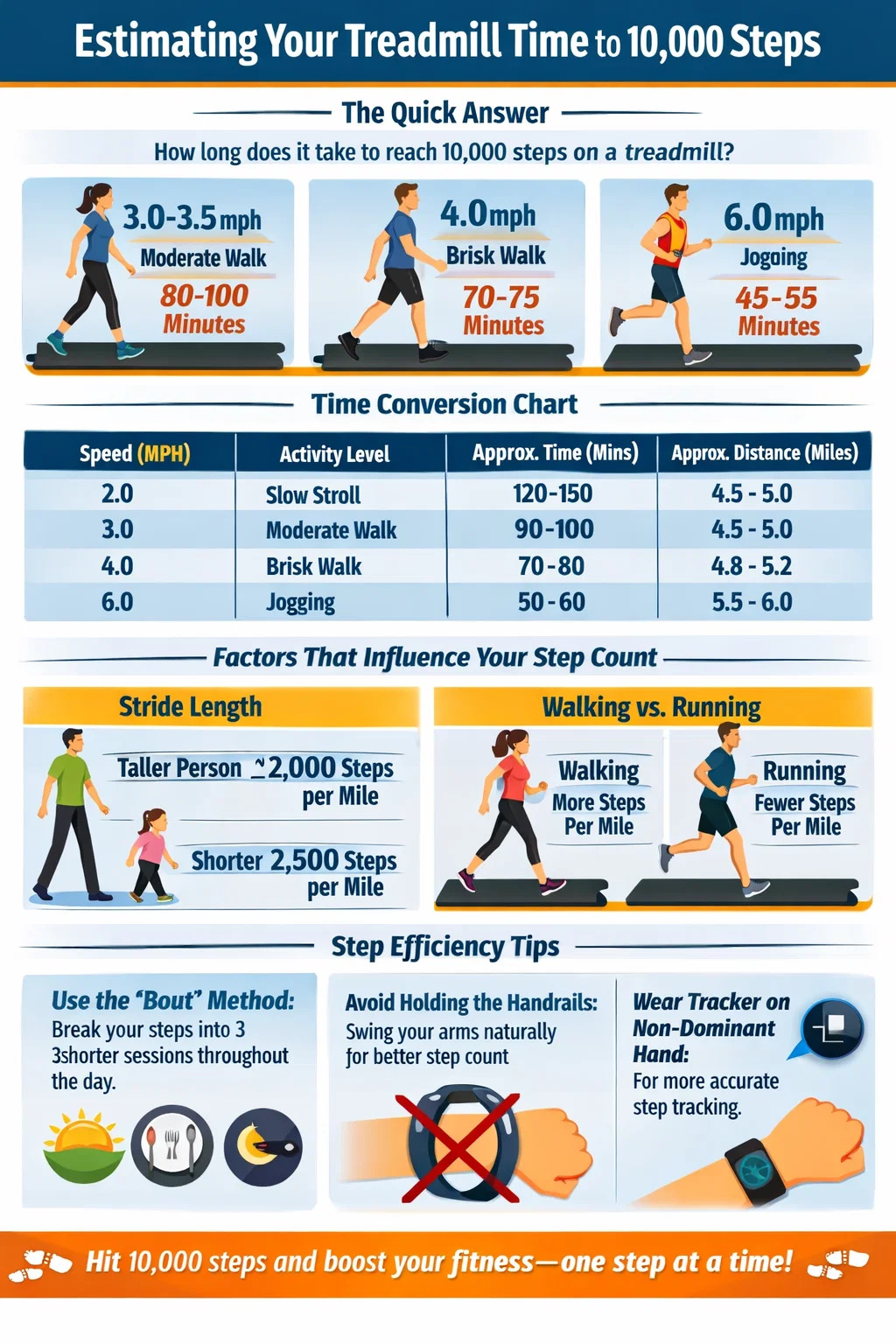
Completing 10,000 steps on a treadmill typically takes between 80 to 100 minutes at a moderate walking pace of 3.0 to 3.5 mph. For a brisk walker moving at 4.0 mph, the time drops to approximately 70 to 75 minutes. If you decide to run at a steady 6.0 mph, you can reach this milestone in roughly 45 to 55 minutes, though your stride length will naturally increase, requiring fewer steps per mile than walking.
It is important to understand that a treadmill tracks distance and speed, but the time required for 10,000 steps varies based on individual biomechanics. Since the belt moves at a constant rate, your body must adapt its cadence to keep up.
Your height is the primary factor in determining stride length. A taller person with longer legs covers more ground per step, meaning they may take 2,000 steps per mile, while a shorter individual might take 2,500 steps to cover the same distance on the treadmill. Consequently, shorter users might hit their 10,000-step goal faster in terms of distance, but the time spent depends on the belt speed.
When you transition from walking to running on a treadmill, your steps become longer and more forceful. While running feels more intense, you are actually taking fewer steps to cover a mile than you would while walking. If your goal is specifically "steps" rather than "distance," a fast walk is often more efficient for racking up high numbers quickly than a long-stride jog.
To help you plan your workout, the following table breaks down the approximate time and distance required to hit 10,000 steps based on common treadmill settings for an average adult.
| Speed (MPH) | Activity Level | Approx. Time (Mins) | Approx. Distance (Miles) |
|---|---|---|---|
| 2.0 | Slow Stroll | 120 - 150 | 4.5 - 5.0 |
| 3.0 | Moderate Walk | 90 - 100 | 4.5 - 5.0 |
| 4.0 | Brisk Walk | 70 - 80 | 4.8 - 5.2 |
| 6.0 | Jogging | 50 - 60 | 5.5 - 6.0 |
If you find it difficult to dedicate 90 continuous minutes to the treadmill, you can use strategic methods to accumulate steps more effectively without burning out.
Instead of one long session, break your 10,000 steps into three smaller bouts. Ten minutes on the treadmill in the morning, fifteen at lunch, and the remainder in the evening makes the goal feel significantly more manageable. Short, intense bursts of walking often result in a higher step cadence than a single, fatigued crawl at the end of the day.
Holding onto the treadmill rails can subtly shorten your stride and reduce your arm swing. Natural arm movement is closely linked to your leg cadence. By letting your arms swing freely, you maintain a more natural gait and typically record more accurate step counts on wrist-based fitness trackers.
Tracking steps on a treadmill can sometimes be finicky compared to walking outdoors. To ensure your 10,000 steps are counted correctly, consider the following:
Hitting 10,000 steps on a treadmill is a fantastic way to ensure cardiovascular health, especially during inclement weather. By choosing a brisk walking speed of around 3.5 mph, you can comfortably finish your daily goal while watching a single movie or a few episodes of your favorite show.
Hot Products

Phone: +86-152 5836 5876
TEL: +86-574 6322 1199
Email: mandy@evbfit.com
Address: No. 518 Zhengtong Road, Kandun Street, Cixi, Ningbo, Zhejiang, China
Copyright © Zhejiang Everbright Industry, Inc. All Rights Reserved. Custom Exercise Bikes Manufacturers China Stationary Bikes Factory