Sep 07, 2026
Content
The most common reason a 30-day treadmill challenge fails is not a lack of willpower. It is a plan that starts too hard. On day one, a new user sets the treadmill to 7 mph or picks a steep incline, and by day three the legs feel heavy, the motivation drops, and the challenge becomes a memory.
A properly built 30-day treadmill challenge starts with a pace you can hold for 20 minutes, adds small changes in speed, incline, or time each week, and includes at least two rest days. That structure is what turns a motivational idea into a real training block. According to the American College of Sports Medicine, adults need at least 150 minutes of moderate-intensity aerobic activity per week. A five-day challenge with 25 to 35 minute sessions reaches that target without requiring heroic effort.
The question is not whether a treadmill challenge is effective. The question is whether you have a plan that accounts for recovery, joint impact, and equipment quality. In this article, you will find a four-week structure that applies to walking, running, and mixed sessions, plus the numbers that matter when you track progress.
A 30-day challenge works because it removes the need to decide what to do each morning. Instead of asking the treadmill screen for a workout, you follow a fixed progression. That progression creates three things: consistency, measurable load, and room to adjust.
The 30-day length matters because it is long enough to see a measurable change and short enough to stay focused. The first week builds the habit. The second week adds duration. The third week introduces incline or speed. The fourth week consolidates the progress you have already made.
The table below gives a practical starting point for a beginner. The speeds are in miles per hour because most home treadmill consoles in North America are calibrated in miles. If your treadmill shows kilometers, multiply the mph figure by 1.6.
| Week | Focus | Session Length | Speed | Incline | Days per Week |
|---|---|---|---|---|---|
| 1 | Build the habit | 20 minutes | 3.0-3.2 mph | 0-1% | 5 |
| 2 | Extend duration | 25 minutes | 3.2-3.4 mph | 1-2% | 5 |
| 3 | Add incline | 30 minutes | 3.4-3.6 mph | 3-4% | 5 |
| 4 | Consolidate | 35 minutes | 3.6-3.8 mph | 4-6% | 5 |
This table is not a prescription. If 20 minutes at 3.0 mph feels taxing, start with 15 minutes at 2.8 mph. If you are a runner, replace the walking speeds with a run/walk ratio and keep the same time and incline structure.
The following breakdown gives you a clearer picture of how the challenge moves from simple to more demanding.
Keep every session the same in the first week. The goal is not to improve your fitness in one week; the goal is to create a routine that does not feel threatening. Each session should be 20 minutes, with five minutes at a very easy pace, 10 minutes at a comfortable pace, and five minutes at an easy pace. The incline stays at 0 to 1 percent.
In week two, add five minutes to every session. The increase can be placed in the middle of the workout rather than at the beginning. For example, a 25-minute session can be five minutes easy, 15 minutes at the same speed as week one, and five minutes easy. Increase the speed by no more than 0.2 mph.
Incline changes the muscle recruitment pattern. It makes the workload harder without forcing you to run faster. For walking, a 3 to 4 percent incline makes the same speed feel like a real outdoor hill. Keep the speed similar to week two, but add one to two percent incline every session. Stop the session if your lower back starts to ache; incline walking is a powerful stimulus.
The final week is about holding the gains. Use two or three sessions at the highest speed and incline of the month. Then use one or two sessions at an easy pace. In the last session, aim for 35 minutes at a moderate pace. Do not try to set a personal record on day 30; save that for a future challenge.
Tracking more than your weight is important. Weight loss is slow, and daily fluctuations can hide real progress. The four numbers below give you a clearer picture.
Heart rate can be useful, but you do not need to chase a number. A commonly used estimate for maximum heart rate is 220 minus age. For a 40-year-old, that gives 180 beats per minute. Moderate exercise usually sits around 60 to 70 percent of that rate, or roughly 108 to 126 beats per minute. If you have a heart rate strap, use that range as a guide and not as a rigid target.
The challenge fails most often because of a small number of predictable errors. Recognizing them before you start is more useful than trying to fix them in week three.
Each of these mistakes has a simple fix. Start at a speed you can hold for the whole session. Always spend five minutes at a very easy speed and one percent incline. Add incline only after your total time has increased. Keep at least one full day of rest between hard sessions.
The quality of your treadmill matters at the mechanical level, not just the digital level. A 30-day challenge creates daily wear on the belt, deck, motor, and frame. The home treadmill market is experiencing a wave of smart upgrades, and while a large touchscreen is convenient, the ability to keep a stable speed and cushion the impact matters more.
From a manufacturing perspective, a treadmill used daily should have a motor rated for continuous duty, a belt width of at least 20 inches, a speed range that can go below 1 mph for warm-ups, and a deck cushioning system that reduces impact on each step. If the treadmill wobbles when you move at 4 mph, the biomechanics of every session become less predictable.
When you choose a treadmill for the challenge, decide whether you will primarily walk or run. A walking-focused plan can tolerate a narrower belt and a lower motor rating, but a running plan needs a larger motor and a wider deck.
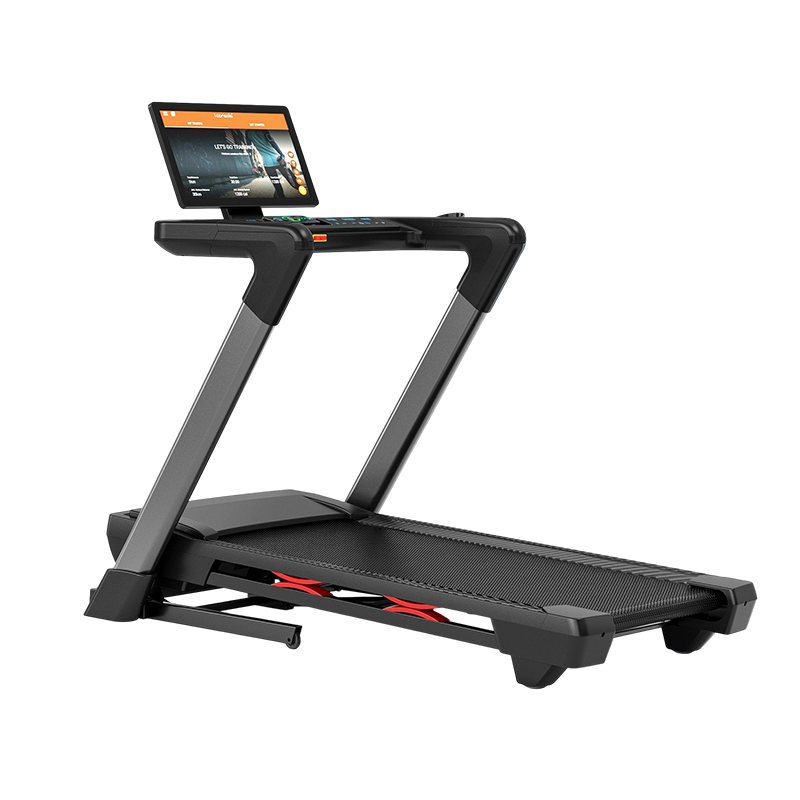 Adjustable Incline Treadmill for Home WorkoutsThis treadmill provides adjustable incline and speed settings for varied intensity, making it suitable for both walking and running routines. With heart rate monitoring and preset programs, it helps personalize training and track progress for effective home workouts.View Product →
The workouts below can be inserted into the four-week structure. They are designed to keep the challenge interesting and to work different energy systems.
| Workout | Best Week | Duration | How to Do It |
|---|---|---|---|
| Easy Base | Week 1-2 | 25 min | 5 min easy warm-up, 15 min steady pace, 5 min easy cooldown |
| Hill Walk | Week 3 | 30 min | 5 min warm-up, then alternate 2 min at 4-5% incline and 2 min at 1% incline |
| Speed Intervals | Week 3-4 | 25 min | 5 min warm-up, then 6 x 1 min fast / 1 min easy, 5 min cooldown |
| Tempo | Week 4 | 30 min | 5 min warm-up, 20 min at a "somewhat hard" pace, 5 min cooldown |
| Long Session | Week 4 | 40 min | 5 min warm-up, 30 min at comfortable pace, 5 min cooldown |
Use the Easy Base workout for most days in weeks one and two. Use the Hill Walk or Speed Intervals once or twice in weeks three and four. The Tempo and Long Session are the strongest finish to the challenge.
Day 31 is not a restart. It is a decision about how to continue. The first choice is to maintain the same frequency for another month. The second is to raise the ceiling: increase one variable, not all of them.
If you have completed 30 days and felt joint pain or persistent fatigue, do not jump into a harder plan. Use the next 30 days to consolidate the habit with lower intensity and greater consistency.
Yes. The challenge works for beginners if the starting speed is comfortable and rest days are included. The plan in this article starts with 20-minute sessions at 3.0-3.2 mph. If that feels too hard, begin with 15 minutes at 2.8 mph.
Five days a week is the most common approach. The plan above uses two full rest days. Some people prefer three training days and one or two light walk days; the important part is to avoid seven days of hard work.
No. Incline is a tool, not a requirement. A beginner can complete the challenge on a flat treadmill and still improve. Incline becomes useful in week three, when your body is ready for a different stimulus.
Treadmill training creates exercise expenditure, but weight loss also depends on food intake. A 30-day treadmill challenge can support a calorie deficit when combined with the same nutrition plan every day. The treadmill itself is not a diet.
Do not try to replace two missed sessions with one longer session. Resume the next scheduled workout. The month is a guide, not a test of discipline.
Use the pace that keeps you able to speak in full sentences. If you cannot finish a sentence while walking, slow down. If you can run a 10-minute mile comfortably, you may use a run/walk ratio instead of a strict walking plan.
The real test of a 30-day treadmill challenge is not the last session. It is the decision you make on day 31. Keep the habit, monitor how your body responds, and adjust from there. A challenge only works if it becomes part of your weekly routine.
Hot Products

Phone: +86-152 5836 5876
TEL: +86-574 6322 1199
Email: mandy@evbfit.com
Address: No. 518 Zhengtong Road, Kandun Street, Cixi, Ningbo, Zhejiang, China
Copyright © Zhejiang Everbright Industry, Inc. All Rights Reserved. Custom Exercise Bikes Manufacturers China Stationary Bikes Factory