Nov 23, 2026
Content
A buyer in Ningbo opens two invoices on the same morning. Line one reads: exercise bike, 92 units. Line two reads: exercise bike, 92 units. The first container holds 47 kg indoor cycling bikes with 15 kg flywheels and narrow racing saddles. The second holds recumbent bikes with step-through frames and 480 mm seat pans. Identical wording on the paperwork, two completely different machines, and one of those two fleets will be sitting unused within a month.
That gap between the words and the hardware is where most purchasing mistakes begin. Stationary bikes and exercise bikes are treated as one category in search bars and on purchase orders, but they are built on different frames, with different duty ratings, different adjustment ranges and different failure points. A hotel that specifies the wrong one loses floor space and a maintenance budget. A distributor that orders the wrong one loses a selling season.
What follows works through the decisions in the order that actually matters: rider position first, resistance system second, frame and adjustment range third, and finally the factory tests that predict whether a bike survives year five. It is written from the production floor rather than the showroom, so the numbers are production numbers.
If you remember only one rule, make it this: the seat position decides whether the bike gets ridden, and the resistance system decides whether it still works in year five. Price sits third, not first. Almost every "my exercise bike is gathering dust" story traces back to a rider who was sold a racing posture when they needed a reclined one.
Translated into practical choices, the short version looks like this:
Posture matters more than most buyers expect because it drives repetition. The World Health Organization's 2020 guidelines on physical activity recommend that adults accumulate 150 to 300 minutes of moderate-intensity aerobic activity per week. A bike that hurts after 12 minutes will not deliver that, no matter how good its resistance curve looks on a spec sheet.
In retail, stationary bike and exercise bike are synonyms. In manufacturing planning, they are not, and confusing them causes real cost. The word "stationary" simply describes a machine that does not travel. The phrase "exercise bike" in a specification document usually signals a home-duty upright or recumbent with a console and magnetic resistance. The same purchase order can therefore hide three different duty cycles behind one label.
Nearly every order book resolves into four families:
If your requirement document does not name one of these four, the factory will choose for you, and the factory will choose whichever frame is cheapest to tool that month.
The geometry that matters on an upright bike is the relationship between three points: the saddle, the crank and the handlebar. On a well-designed frame the seat post travels through eight to twelve locking positions and covers an inseam range of roughly 70 cm to 95 cm. Crank length typically sits between 165 mm and 175 mm. Pedal spacing, usually called Q-factor, runs about 160 mm to 180 mm on home frames; anything wider than 190 mm starts to feel like pedalling on a horse and quietly drains efficiency.
Two details separate a bike that lasts from one that rattles in year two:
For apartments and small hotel corners, a step-through frame with a 250 to 300 mm standover height is easier to mount and easier to move on transport wheels. Buyers who want the full geometry breakdown, from crank ratio to reach adjustment, can read our principles-to-purchase guide to upright exercise bikes alongside this article.
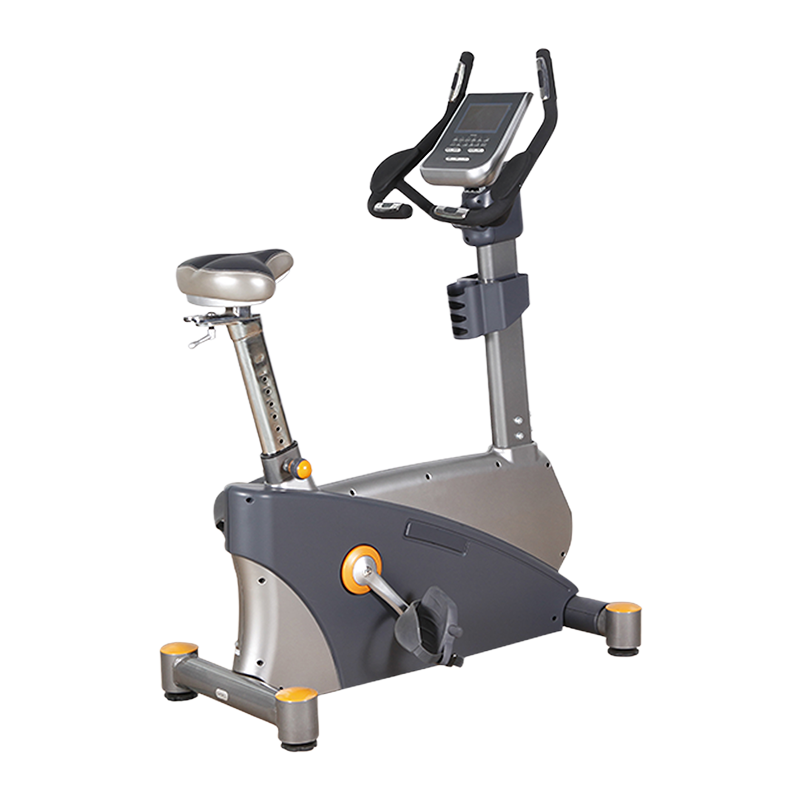
One example from our own range is the SB03 upright stationary bike, built with a belt drive and multi-position seat post for exactly this home and light-commercial segment.
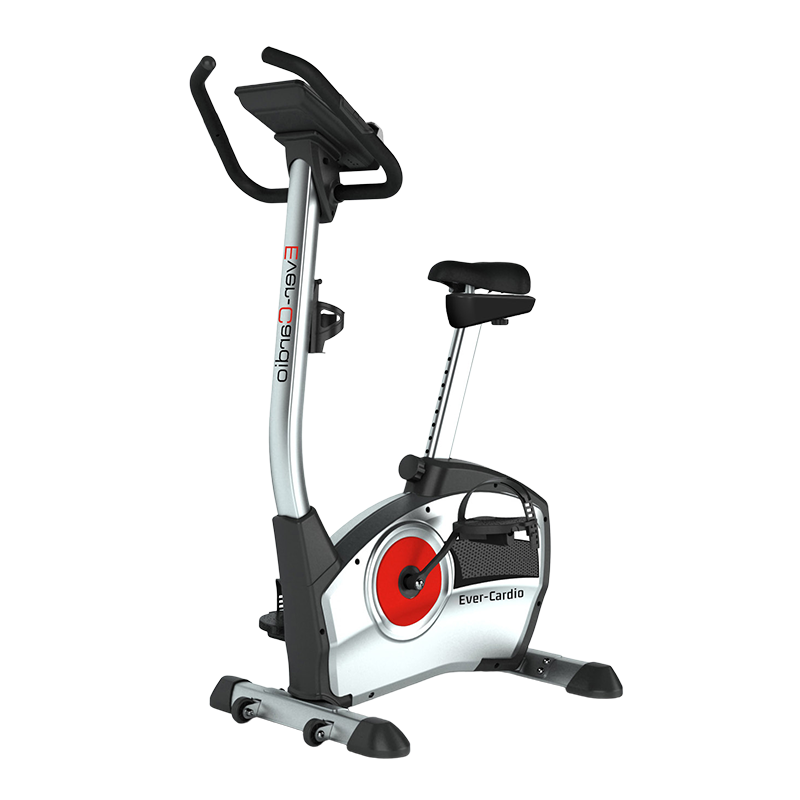 SB03 Upright Exercise Stationary BikesInstrument Features: 1) The smart display tracks and records the user's exercise data, helping users better understand their exercise status and results. This can be u...View Product →
Recumbent bikes move the crank forward and place the rider in a reclined position with the seat back angled between 100 and 115 degrees. The seat pan is the whole point. Home models typically run 350 to 420 mm wide, while comfort-focused models reach 480 mm or more with thicker foam and a lumbar curve. Step-through entry height usually sits under 300 mm, which matters for older riders and anyone with restricted hip or knee movement.
Recumbents trade peak power for duration. A rider who can hold 20 minutes upright will often hold 40 minutes reclined, because the load moves from wrists, shoulders and lower back onto the glutes and legs. That is why rehabilitation rooms, senior centres and hotel wellness areas order recumbents far more often than spin bikes, even though the spin bike looks more impressive in a brochure photograph.
Four checks before you sign off a recumbent specification:
In our own catalogue, the EB3200L recumbent bike uses extra-large seat cushions and a reinforced rail for high-hour comfort use.
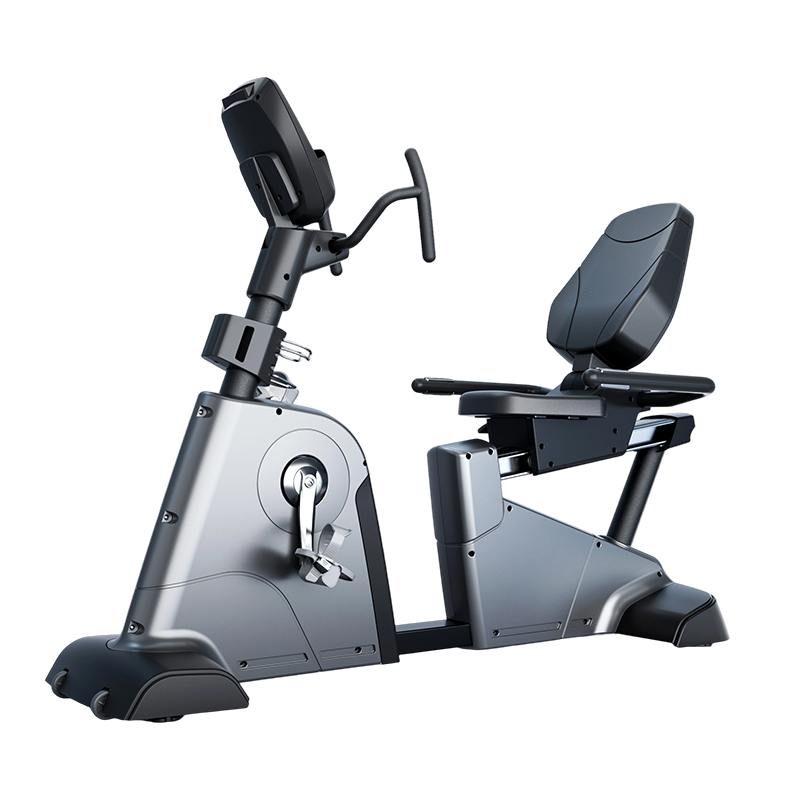 EB3200L Extra-large Seat Cushions Recumbent BikeInstrument Features: 1) The 350*270 panel displays a variety of information, including speed, distance, and calorie consumption, helping users fully understand their e...View Product →
Indoor cycling bikes are the least forgiving of the three families, and that is deliberate. The geometry is fixed and close to a road position, the flywheel runs 15 to 22 kg, the Q-factor narrows to roughly 150 mm to 170 mm, and the drive is either a belt or a chain. The heavier flywheel is not there to make pedalling harder; it is there to keep cadence smooth through the dead spot at the top and bottom of each stroke.
The number one killer of indoor cycling bikes is not load. It is sweat. A rider losing a litre of fluid per session deposits salt water onto the frame, the seat post, the handlebar and the console buttons. Machines that survive six years in a studio share three traits: a powder-coated frame in the 60 to 80 micron range, sealed cartridge bearings in the bottom bracket, and stainless or plated fasteners rather than painted steel bolts.
Also check the pedal interface. Integrated pedals with adjustable toe cages suit shared classes; pedals with a clip-in mechanism on one side and a cage on the other suit mixed users. Threaded steel inserts, not aluminium, are what stop a stripped crank arm after two heavy riders.
The SP02 indoor bike with integrated pedals is the format we build for studio-style training rooms.
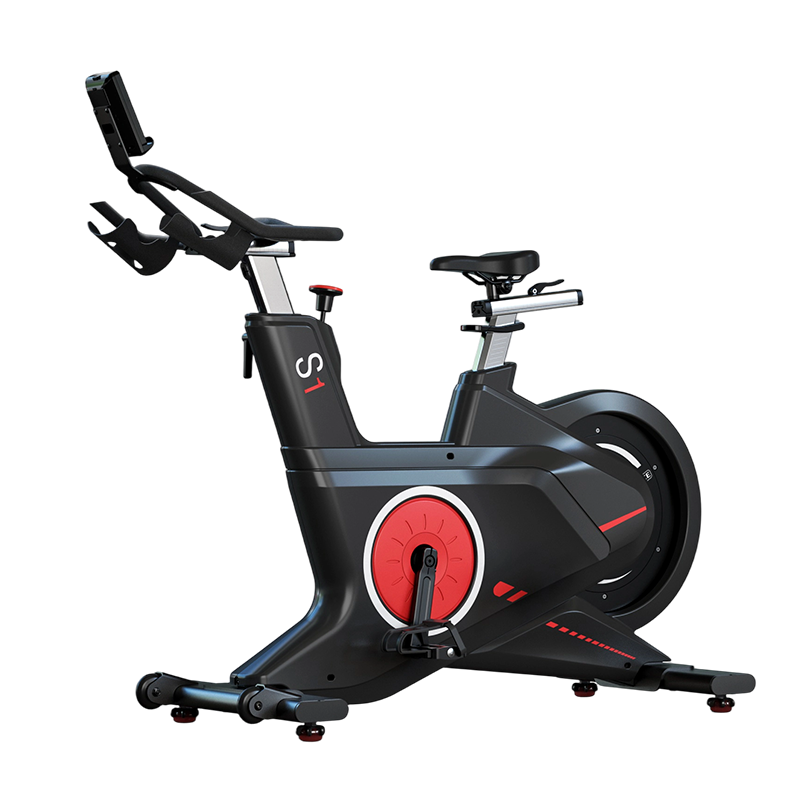 SP02 Indoor Bike With Integrated PedalsInstrument Features: 1) The SM1731 electronic watch features time, speed, distance, calorie consumption, program settings, and Bluetooth connectivity, comprehensively ...View Product →
Resistance is where specification sheets get vague. "Magnetic resistance" can mean a simple manual knob moving two magnets, or a motorised eddy-current system with 32 electronically controlled levels. Those are not the same product, and they do not cost the same to maintain.
| System | How it works | Riding feel | Upkeep | Best fit |
|---|---|---|---|---|
| Friction pad | A felt or leather pad presses against the flywheel rim | Smooth but fades as the pad wears | Pad swap every 6 to 18 months | Entry-level indoor cycling bikes |
| Eddy-current magnetic | Magnets approach the flywheel without touching it | Silent, consistent, often 8 to 32 levels | Almost none beyond dust control | Home upright and recumbent bikes |
| Self-generating electromagnetic | The rider turns a generator that feeds the console and magnets | Constant torque even below 40 rpm | None; no outlet or cable required | Commercial gyms, outlet-free rooms |
| Air fan | Blades push air as cadence rises | Resistance climbs with speed; loud | Blade and cage inspection | Cross-training and rehab corners |
The takeaway: if the room has no reliable power point near the machine, specify self-generating resistance and cross it off your electrical plan early. Retrofitting a cable run later costs more than the upgrade on the bike itself.
Five specification lines cause most of the arguments between buyers and factories.
| Parameter | Home duty | Light commercial | Full commercial |
|---|---|---|---|
| Daily use | 1 to 2 hours | 3 to 6 hours | 8 to 14 hours |
| Flywheel mass | 6 to 10 kg | 10 to 15 kg | 15 to 22 kg |
| Frame tube wall | 1.5 to 2.0 mm | 2.0 to 2.5 mm | 2.5 to 3.0 mm |
| Console power | Battery | Mains or self-powered | Self-powered with data output |
Reliability on a stationary bike is rarely dramatic. Machines do not snap in half; they develop play, noise and drag in a predictable order. Ranked by frequency of complaint in service records, the sequence runs like this: bottom bracket bearings, drive belt tension, pedal threads, seat post clamps, then console buttons.
Manufacturers who test for this do three things on the line. They run an endurance rig to 200,000 crank revolutions under load, which at 80 rpm is roughly 40 hours of continuous pedalling squeezed into a week. They put coated frames through salt-spray exposure in the region of 200 hours to catch paint and weld corrosion before it reaches a coastal gym. And they load the seat post with a static weight well above the rated user figure, because a slipping saddle is the fastest way to lose a rider's trust.
Vertical integration helps here. Our plant in Ningbo covers 127,000 square metres across seven workshops handling welding, coating, spraying, parts production and final assembly, with eight production lines. When welding, coating and assembly sit inside one fence, a change to the weld fixture on a Tuesday shows up in the finished frame on Thursday instead of waiting for a container to cross an ocean.
Use this list as a written requirement, not a conversation. Anything left unstated will be resolved in the supplier's favour.
Buyers who want to see how these frames are put together across the whole cardio line can browse the full indoor cardio range and compare families side by side before writing the specification.
In everyday language, yes. Both describe an indoor bike that does not travel. In manufacturing, the label covers at least four different frames with different duty ratings, so a specification should always name the family and the daily use hours rather than relying on the general term.
At the same power output, calorie expenditure is nearly identical. The practical difference is duration: recumbent riders commonly hold a session 30 to 100 percent longer because the load is distributed across the glutes and seat pan instead of the wrists and lower back. Total work over a week usually favours whichever bike the rider actually returns to.
For home upright and recumbent bikes, 6 to 10 kg is enough to smooth the pedal stroke. Indoor cycling bikes benefit from 15 to 22 kg, which keeps cadence steady during standing climbs. Beyond roughly 22 kg the extra mass mostly adds shipping cost and floor-loading, not riding quality.
No. On a self-generating design the rider turns a small generator that powers the console and the magnet circuit. A small internal battery or capacitor keeps the display alive for a short period after the rider stops. This removes cable routing from the fit-out plan and makes the bike usable during a power interruption.
Very little. Eddy-current magnetic systems have no contact surface to wear, so upkeep is limited to keeping dust out of the flywheel housing and checking that the resistance cable or motor responds smoothly. Budget one inspection every six months in a home setting and every three months in a gym.
Most home frames are rated between 110 kg and 120 kg, which typically corresponds to a static load test around 150 kg. Riders close to that limit should look for a light commercial frame with a 2.0 mm or thicker tube wall and a steel seat post insert rather than aluminium.
Yes, if it is specified for the higher duty. A light commercial rating of 3 to 6 hours per day covers an apartment gym, a hotel fitness corner or a corporate wellness room, and it will comfortably outlast home use. Specifying downward is the mistake; specifying upward only costs weight and money.
A correctly tensioned belt on a home bike commonly runs five to eight years before replacement. The failure signs are a chirping noise under load, visible glazing on the belt ribs and a gradual loss of resistance at the top of the range. Chains need lubrication more often but tolerate misalignment better, which is why studio bikes sometimes still use them.
The pattern behind every good exercise bike order is the same. Someone wrote down the rider's posture, the room's duty cycle and the resistance technology before the price column was filled in. A stationary bike is a simple machine, but it is not a generic one, and the two terms on the invoice will keep hiding four different products until a specification says otherwise.
Compare families first, then compare frames, then compare numbers. The bike that matches the rider on day one is the one that is still working in year five.
Hot Products

Phone: +86-152 5836 5876
TEL: +86-574 6322 1199
Email: mandy@evbfit.com
Address: No. 518 Zhengtong Road, Kandun Street, Cixi, Ningbo, Zhejiang, China
Copyright © Zhejiang Everbright Industry, Inc. All Rights Reserved. Custom Exercise Bikes Manufacturers China Stationary Bikes Factory